
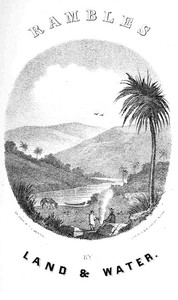
Rambles by Land and Water; or, Notes of Travel in Cuba and Mexico by Norman
Published in 1845, Rambles by Land and Water is Benjamin Moore Norman's personal account of his journeys through Cuba and Mexico. He wasn't a famous explorer, just a well-read New York bookseller with a keen eye. The book reads like a series of detailed letters home, moving from the bustling port of Havana to the grand, fading streets of Mexico City.
The Story
There isn't a traditional plot. Instead, Norman acts as our guide. In Cuba, he describes the shocking reality of the sugar plantations and the slave economy that powered them, contrasting it with the beauty of the landscape. He then sails to Mexico, arriving just a few years before the Mexican-American War. He travels through Veracruz, Puebla, and finally to the capital, painting vivid pictures of ancient Aztec ruins, crowded marketplaces, and grand cathedrals. He meets everyone from wealthy landowners to local artisans, and he doesn't shy away from noting the political instability and the palpable anxiety about American expansionism. The journey is the story—a snapshot of two nations from a very particular, and sometimes uncomfortable, American point of view.
Why You Should Read It
This book grabbed me because of its raw honesty. Norman is a product of his time, and his views can be jarring, but that's what makes it valuable. You're not getting a polished history lesson; you're getting a real person's reactions. His descriptions of places like the Cathedral in Mexico City or the view from a volcano are incredibly vivid. More importantly, you feel the tension in the air. Reading his observations about Mexico, knowing that war broke out so soon after, gives the whole narrative a layer of dramatic irony. It's a chance to see history not as dates and outcomes, but as the lived experience of someone who was there, trying to make sense of it all.
Final Verdict
Perfect for history buffs who want to move beyond textbooks and for travelers who love the idea of vintage adventure. If you enjoy primary sources and can read with a critical eye toward the author's 19th-century perspective, you'll find this a treasure trove. It's not a fast-paced novel, but a slow, thoughtful walk through a pivotal moment in time, led by a surprisingly observant companion.
This historical work is free of copyright protections. Knowledge should be free and accessible.
Donald Gonzalez
5 months agoLooking at the bibliography alone, the concise summaries at the end of each section are a lifesaver. I appreciate the effort that went into this curation.
Sarah Moore
4 months agoI found the data interpretation to be highly professional and unbiased.
Jessica White
3 months agoThis is an essential addition to any academic digital library.
William Harris
3 months agoThe research depth is palpable from the very first chapter.


Margaret Lee
5 months agoAfter spending a few days with this digital edition, the critical analysis of current industry standards is very timely. A rare gem in a sea of mediocre content.