1

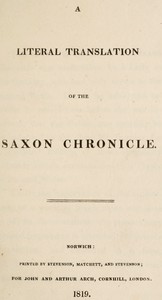
A literal translation of the Saxon chronicle — A Reader’s Guide
(0 User reviews)
837
Project Gutenberg
2025
Not confirmed
Great Britain -- History -- Anglo-Saxon period, 449-1066 -- Sources
Readers of public-domain and historical texts
Project Gutenberg digital edition
en
Edition facts
Words
78,120
Reading time
340 min
Text sections
12
This digital edition of A literal translation of the Saxon chronicle — A Reader’s Guide is described by source-level measurements including 78,120 words, 5 hr 40 min estimated reading time, and 12 detected text sections.
The text analysis averages about 29.4 words per sentence, while the detected sections provide another way to judge how the source is divided.
Project Gutenberg metadata also associates the work with “Great Britain -- History -- Anglo-Saxon period, 449-1066 -- Sources,” connecting these edition facts with the source record’s subject description.
Source:
Project Gutenberg record #75186
Anna Gurney's 1819 literal translation of the Anglo-Saxon Chronicle, produced for private circulation before Ingram's edition, preserves the terse, annalistic voice of the original. The excerpts reveal stark contrasts: the opening geographical and ethnological survey versus later violent raids, and the chronicler's matter-of-fact tone amid descriptions of plunder and fire.
Editorial Edition Score
4.8/5
★★★★★
★★★★★
Calculated from edition completeness, EPUB availability, text structure and catalogue metadata. Not a user rating.
How this score is calculated
- Description quality20 pts
- Title & short description10 pts
- Source metadata20 pts
- Text length15 pts
- Chapters / structure15 pts
- EPUB file integrity20 pts
Total of 100 points, scaled to a 2.5-5.0 range. Editions with an empty description or a missing EPUB file are not scored.
Edition quality
Public-domain source text
Read the source text
The source text is kept in the dedicated reader, separate from this catalogue record and its commentary.
Anna Gurney's 1819 translation of the Saxon Chronicle was undertaken with only printed texts and was nearly complete before she learned of the Rev. Mr. Ingram's forthcoming collated edition. The present version, intended for private circulation, is described as a 'very limited impression' executed in a form convenient for reference. The excerpts reveal a work that begins with a measured geographical and ethnological account of Britain—detailing its length, breadth, and five nations—before shifting abruptly into annals of invasion, plunder, and ecclesiastical violence. The chronicler's voice remains consistently terse, even when recording the burning of a monastery or the theft of a golden crown from a crucifix.
A Chronicle of Contrasts: Geography and Violence
The opening passage of the Chronicle presents a systematic description of Britain: its dimensions, its five nations (English, Britons or Welch, Scots, Picts, and Romans), and the legendary origins of the Picts and Scots. The narrative is orderly, almost ethnographic, tracing migrations and settlements with a calm, cataloguing tone. Yet this measured beginning gives way to accounts of brutal conflict. The same annalistic voice that records the length of the island also reports, without rhetorical flourish, that 'Caius Julius, the Roman Emperor, came to Britain with 80 ships' and was 'overcome in a terrible battle.' The juxtaposition is stark: the chronicler treats geographical data and military disaster with equal brevity, as if both are simply facts to be entered in the record.
The Matter-of-Fact Recording of Desecration
One of the most striking passages describes the sacking of a monastery. The outlaws 'climbed up to the holy crucifix, and took the crown from our Lord's head, which was all of the purest gold, and they took the footstool of red gold from under his feet.' The detail is precise and visual, yet the tone remains neutral. The chronicler notes that the attackers 'said they did this because of their allegiance to the monastery'—a claim left uncommented upon. The narrative then follows the stolen treasure to its fate: a storm scatters the ships, and the remaining spoils are stored in a church that later burns 'through their carelessness and drunkenness.' The chronicler's only exclamation is a prayer: 'May Almighty God have pity on it in his great mercy.'
The Translator's Position and the Text's Provenance
Gurney's preface reveals that her translation was 'far advanced towards its completion' before she learned of Ingram's work. She describes her version as a 'very limited impression' for private circulation, suggesting a scholarly rather than commercial aim. The excerpts show that her translation is indeed literal, preserving the original's paratactic style and abrupt transitions. For instance, the annal for the year of the monastery's burning ends with a note on a famine and a fleet's movement, then jumps to the death of Earl Baldwin. This lack of connective tissue is characteristic of the Chronicle's annalistic form, and Gurney's fidelity to it gives modern readers direct access to the medieval scribe's perspective.
Readers approaching this translation should attend to the gaps and silences as much as to the events recorded. The chronicler's flat tone when describing atrocities is not indifference but a convention of the genre. Gurney's literal rendering preserves that convention, making the violence all the more striking for its understatement. The work rewards those who read slowly, noting how the same voice that measures the island in miles also measures the weight of gold stolen from a crucifix.
I keep coming back to Anna Gurney’s plain, stark lines about fire and plunder, where the old monks never flinch. It reminds me how quiet the land once felt, before those raids. Yet that earlier, gentler survey lingers too, like a half-remembered map. There’s something tender in comparing that first geography with Chronicles (1 of 6): The Description of Britaine — Inside the Classic, as if two voices were speaking across centuries, one trusting, one wary.
There are no reviews for this eBook.
There are no comments for this eBook.
Reader reflection
What did you think of this book?
Answer a few questions and save a private reflection on this device.
Your progress
0
/
10
2
What was your overall reaction to the book?
3
Is this a title you would suggest to others?
4
What was the reading difficulty like?
5
Would a second reading be valuable?
6
How useful were the ideas in this book?
7
How personally connected did you feel to the book?
8
What was the strongest part of the book?
9
What did this book teach you most?
10