1

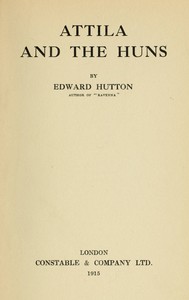
Attila and the Huns — A Reader’s Guide
(0 User reviews)
414
Project Gutenberg
2023
Not confirmed
Attila, -453; Huns
Readers of public-domain and historical texts
Project Gutenberg digital edition
en
Edition facts
Words
45,901
Reading time
200 min
Text sections
26
Attila and the Huns — A Reader’s Guide can be approached with a clearer sense of reading commitment from its source measurements: 45,901 words, 3 hr 20 min estimated reading time, and 26 detected text sections.
The text analysis averages about 23.2 words per sentence, while the detected sections provide another way to judge how the source is divided.
Project Gutenberg metadata also associates the work with “Attila, -453,” connecting these edition facts with the source record’s subject description.
Source:
Project Gutenberg record #72031
Edward Hutton's 1915 study of Attila and the Huns, framed by contemporary politics and drawing on classical sources, examines the Hun leader's campaigns, his confrontation with Pope Leo I, and the legacy of his failed invasions.
Editorial Edition Score
4.9/5
★★★★★
★★★★★
Calculated from edition completeness, EPUB availability, text structure and catalogue metadata. Not a user rating.
How this score is calculated
- Description quality20 pts
- Title & short description10 pts
- Source metadata20 pts
- Text length15 pts
- Chapters / structure15 pts
- EPUB file integrity20 pts
Total of 100 points, scaled to a 2.5-5.0 range. Editions with an empty description or a missing EPUB file are not scored.
Edition quality
Public-domain source text
Read the source text
The source text is kept in the dedicated reader, separate from this catalogue record and its commentary.
Edward Hutton opens his 1915 study of Attila and the Huns not with a neutral historical survey but with a pointed political analogy. He quotes Claudian's poetic description of the Huns—'Bare is their garb, their bodies foul to view'—and immediately juxtaposes it with Kaiser Wilhelm II's 1900 speech urging German troops to emulate the Huns in China. This framing, written during the First World War, sets the tone for a work that is as much about contemporary European tensions as about the fifth-century steppe warriors.
Hutton acknowledges the scarcity of reliable evidence: 'We know so little of the Huns of the fifth century: who they were, whence indeed they came and whither they went.' He engages with ethnological theories, citing Quatrefages to argue that Prussians are 'essentially Finno-Slavian' rather than Teutonic, a claim he uses to question German racial unity. The reader should be aware that this is a polemical history, where ancient events are refracted through modern nationalism.
The Poet's Huns and the Kaiser's Huns
Hutton's introduction is built on a double quotation. He first reproduces Claudian's late fourth-century verses, which depict the Huns as a savage race beyond the Tauris, their 'sustenance is spoil' and their customs include gashing their brows. Then he prints the Kaiser's 1900 address to German troops departing for China: 'Just as the Huns a thousand years ago under the leadership of Attila gained a reputation... so may the name of Germany become known.' The juxtaposition is deliberate. Hutton uses the classical poet to establish a traditional image of Hunnic barbarity, then shows how that image was weaponized by a modern ruler. He notes that the Kaiser's words 'have since been translated into action not only upon the Chinese but upon the body of Europe,' referencing Belgian and French suffering. This opening strategy signals that the book will treat historical narrative as a tool for political commentary, not as an end in itself.
The Limits of Historical Knowledge
Hutton is candid about the fragmentary nature of his sources. He writes that 'we know so little of the Huns of the fifth century' that it is impossible to assert or deny a direct link to modern Prussians. He dismisses Gibbon's theory, taken from De Guignes, that the Huns were identical with the Hioung-nou of Chinese records, though he offers no alternative origin. Instead, he classifies them as a 'Turanian race,' grouping them with Finns, Bulgarians, Magyars, Croatians, and Turks. This broad categorization relies on nineteenth-century ethnology rather than modern genetics or linguistics. Readers should note that Hutton's argument about Prussian racial origins—citing Quatrefages to claim that Prussia's population is 'essentially Finno-Slavian'—is used to undermine German claims of racial unity. The historical evidence for Hunnic origins remains thin, and Hutton's assertions are shaped by his polemical purpose.
The Embassy of Pope Leo the Great
The later excerpt describes the famous meeting between Attila and Pope Leo I in 452. Hutton emphasizes that Leo did not go alone: with him were 'two illustrious nobles, the Consul Gennadius Avienus... and the Prefect Trigetius.' They met Attila on the Mincio near Mantua, at a place called the Campus Ambuleius. Hutton describes Leo's vestments—'the golden mitre, a chasuble of purple with the pallium'—and reports that Attila saw 'the mighty figures of S. Peter and S. Paul' in the sky and bowed his head. Yet Hutton immediately complicates this miraculous account. He notes that the treaty involved 'an annual tribute to the Hun' and that Aetius and Marcian were 'probably indirectly responsible' for Attila's retreat. The Pope's success, Hutton suggests, was not solely divine: Roman armies and Byzantine threats played a role. This balanced treatment shows Hutton weighing hagiographic tradition against strategic reality.
Attila's Homecoming as Failure
Hutton's final excerpt presents Attila's return to Hungary as a catalogue of defeats. 'He had struck first the East and perhaps ruined it, but he had failed to take Constantinople. He had struck Gaul and left its cities shambles, but he had not destroyed the armies of Aetius. He had desired Rome for his plunder and his pride, but Leo had turned him back.' The repetition of 'he had... but' structures the paragraph as a litany of unfulfilled ambitions. Hutton concludes that Attila 'returned to his wooden stockade in the heart of Hungary with all his hopes unfulfilled, all his achievements undone, a ruined man.' The language is stark and judgmental. Hutton adds that Attila's failure to realize his own ruin 'is but to emphasise the fact that he was a Barbarian.' This moralizing verdict fits the book's broader argument: that barbarism, whether Hunnic or Prussian, ultimately leads to self-destruction.
Hutton's Attila and the Huns is a work of its time: a First World War polemic that uses fifth-century history to comment on German militarism. Readers will find a narrative that moves from classical poetry to contemporary politics, from ethnological speculation to dramatic set-pieces like Leo's embassy. The excerpts show Hutton's willingness to acknowledge historical uncertainty even as he advances a strong thesis. For a first reading, pay attention to how he selects and frames his evidence—the quotations, the asides, the moral judgments—and consider how the 1915 context shapes his portrait of Attila.
I remember my first glimpse of Francis I, that restless king who seemed to embody France's old chivalry, in A Popular History of France from the Earliest Times, Volume 1 — Reading Companion. Reading Hutton's account of Attila's pause before the gates of Orleans, I felt the same quiet astonishment—how borders hold history for a moment, then let it spill through.
There are no reviews for this eBook.
There are no comments for this eBook.
Reader reflection
How did this book work for you?
Your answers remain private and are stored only in this browser.
Your progress
0
/
10
2
Was reading this book enjoyable?
3
How likely are you to recommend this book?
4
Did the language feel accessible?
5
How personally connected did you feel to the book?
6
How clearly were the main ideas presented?
7
How useful did the reading feel?
8
Do you expect to return to this book?
9
In one sentence, what did you learn?
10