1

Five Years' Explorations at Thebes A Record of Work Done 1907-1911 by The Earl of Carnarvon and Howard Carter — Inside the Classic
(0 User reviews)
37
Project Gutenberg
2015
Not confirmed
Excavations (Archaeology) -- Egypt; Thebes (Egypt : Extinct city)
Readers of public-domain and historical texts
Project Gutenberg digital edition
en
Edition facts
Words
40,794
Reading time
178 min
Text sections
12
The catalog record for Five Years' Explorations at Thebes A Record of Work Done 1907-1911 by The Earl of Carnarvon and Howard Carter — Inside the Classic provides practical reading context through 40,794 words, 2 hr 58 min estimated reading time, and 12 detected text sections.
The text analysis averages about 14.5 words per sentence, while the detected sections provide another way to judge how the source is divided.
Project Gutenberg metadata also associates the work with “Excavations (Archaeology) -- Egypt,” connecting these edition facts with the source record’s subject description.
Source:
Project Gutenberg record #48382
Carnarvon and Carter's excavation report from 1907-1911 details discoveries in the Theban Necropolis, including tomb chapels, a game board, and jewelry, with contributions from multiple scholars.
Editorial Edition Score
4.8/5
★★★★★
★★★★★
Calculated from edition completeness, EPUB availability, text structure and catalogue metadata. Not a user rating.
How this score is calculated
- Description quality20 pts
- Title & short description10 pts
- Source metadata20 pts
- Text length15 pts
- Chapters / structure15 pts
- EPUB file integrity20 pts
Total of 100 points, scaled to a 2.5-5.0 range. Editions with an empty description or a missing EPUB file are not scored.
Edition quality
Public-domain source text
Read the source text
The source text is kept in the dedicated reader, separate from this catalogue record and its commentary.
The volume opens with a preface by the Earl of Carnarvon, dated August 1911 from Highclere, acknowledging Howard Carter's systematic recording and the support of scholars such as Sir Gaston Maspero. The report is structured as a collaborative record, with chapters contributed by specialists like F. Ll. Griffith and Wilhelm Spiegelberg, each addressing specific finds. This multi-author approach sets the tone for a detailed, evidence-based account of five seasons of work in the Theban Necropolis.
A Collaborative Record of Excavation
The preface and introduction establish the work as a joint effort. Carnarvon credits Carter with “unremitting watchfulness and care in systematically recording, drawing, and photographing everything as it came to light.” The list of contributors—including Griffith, Legrain, Möller, Newberry, and Spiegelberg—indicates that the report draws on specialized expertise for different artifact types. Readers should note that the narrative is not a single authorial voice but a compilation of field notes and scholarly analyses. The table of contents reveals a logical progression from tomb architecture (Chapter I) to inscriptions (II), statuettes (III), and broader excavations (IV–XII), each chapter likely reflecting the contributor’s focus.
Reconstructing an Ancient Game
One of the most vivid passages describes a game board found during excavations, with a detailed reconstruction of play. The authors present a simulated match between “Hounds” and “Jackals,” complete with dice throws and movement rules. For example, the text records: “1st H. Cast 3 = hole 8” and tracks progress toward a goal. This section demonstrates the excavators’ willingness to infer ancient practices from material evidence. The game’s rules are presented as a plausible hypothesis, not a definitive conclusion. Readers can observe how the authors blend archaeological data with imaginative reconstruction, a method that recurs throughout the volume.
Jewelry and Material Culture
The description of a necklace found in situ offers insight into preservation challenges. The authors note that beads were “strung in the ancient colour order, viz. red, blue, yellow, and green,” using cornelian, lapis lazuli, gold, and matrix of emerald. They explain that the gold beads’ wax cores have “amalgamated, and the holes are completely choked,” preventing restringing. This level of detail—including the admission that “to re-bore them would endanger their being split”—reflects the excavators’ careful handling of fragile artifacts. A second, smaller necklace includes amulets such as “the eye, hand, rope-knot, crouching lions, crocodiles, flies,” though the authors concede that “the position of these amulets… can only be a matter of conjecture.”
Photographic and Illustrative Evidence
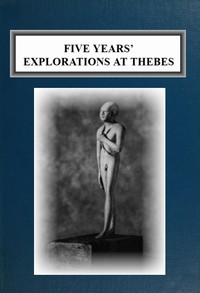
The volume is heavily illustrated, with references to plates and figures throughout. The frontispiece shows an “Electrum Statuette of a Youth” from the XVIIIth Dynasty, and the text frequently directs readers to illustrations, such as “Pl. LI. 2” for the obsidian and gold necklace. The etext includes a note that clicking on symbols or images may enlarge them. This visual component is integral to the report; the authors rely on plates to convey details that text alone cannot capture. Readers should consult the illustrations alongside the narrative to fully appreciate the artifacts’ condition and craftsmanship. The list of plates at the end provides a comprehensive index of visual materials.
This report rewards readers who engage with its collaborative structure and detailed observations. The game reconstruction, jewelry descriptions, and reliance on plates exemplify the authors’ method: combining meticulous recording with cautious inference. As a primary source, it offers a window into early 20th-century archaeological practice in Egypt, before the discovery of Tutankhamun’s tomb. Approach each chapter as a specialist’s contribution, and note how the editors balance technical precision with accessible narrative.
I have spent many evenings in this company, turning the pages of Carnarvon and Carter's careful work. They measured and sketched, revealing small treasures from the Theban dust. There's a fortitude there, a patience with ancient things. That same quiet determination lives in The Seven Great Monarchies Of The Ancient Eastern World, Vol 2: Assyria The History, Geography, And Antiquities Of Chaldaea, Assyria, Babylon, Media, Persia, Parthia, And — Reading Notes; it too worries its fingers along the edges of vanished empires.
There are no reviews for this eBook.
There are no comments for this eBook.
Reader reflection
What did you think of this book?
Answer a few questions and save a private reflection on this device.
Your progress
0
/
10
2
How much did you enjoy the reading experience?
3
Would you encourage someone else to read it?
4
How easy was the book to follow?
5
Did the book deliver what you hoped for?
6
Did the story or argument move comfortably?
7
Would a second reading be valuable?
8
Did anything about the book feel genuinely new?
9
In one sentence, what did you learn?
10