1

History of Scotland — Themes and Context
(0 User reviews)
834
Project Gutenberg
2013
Not confirmed
Scotland -- History -- Outlines, syllabi, etc.
Readers of public-domain and historical texts
Project Gutenberg digital edition
en
Edition facts
Words
69,802
Reading time
304 min
Text sections
7
The source record for History of Scotland — Themes and Context measures this digital text at 69,802 words, 5 hr 4 min estimated reading time, and 7 detected text sections.
The text analysis averages about 21.9 words per sentence, while the detected sections provide another way to judge how the source is divided.
Project Gutenberg metadata also associates the work with “Scotland -- History -- Outlines, syllabi, etc.,” connecting these edition facts with the source record’s subject description.
Source:
Project Gutenberg record #44121
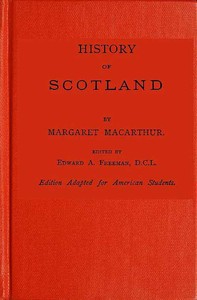
This editorial note examines the structural design of Margaret Macarthur's 1874 school history, focusing on its chronological framework, recurring images of flight and siege, and the movement between council chambers and battlefields.
Editorial Edition Score
4.7/5
★★★★★
★★★★★
Calculated from edition completeness, EPUB availability, text structure and catalogue metadata. Not a user rating.
How this score is calculated
- Description quality20 pts
- Title & short description10 pts
- Source metadata20 pts
- Text length15 pts
- Chapters / structure15 pts
- EPUB file integrity20 pts
Total of 100 points, scaled to a 2.5-5.0 range. Editions with an empty description or a missing EPUB file are not scored.
Edition quality
Public-domain source text
Read the source text
The source text is kept in the dedicated reader, separate from this catalogue record and its commentary.
Margaret Macarthur's History of Scotland, edited by Edward A. Freeman and published in 1874, organizes Scottish history into seven distinct periods, from the Gaelic era through the Union of the Crowns. The book's structure is built around a clear chronological framework, reinforced by detailed tables of key events at the start of each chapter. Within this framework, Macarthur employs recurring images of flight and siege—such as the Queen's flight to Dunbar after Rizzio's murder or the retreat of rebel lords to England—to dramatize moments of political crisis. The narrative moves frequently between council chambers, where plots are hatched, and battlefields or castles, where those plots unravel.
A Framework of Periods and Tables
Macarthur divides Scottish history into seven named periods—such as "The Gaelic Period" and "The Struggle for Independence"—each introduced by a chronological table listing key dates and events. These tables serve as a structural backbone, allowing the reader to see the sequence of invasions, battles, treaties, and royal successions at a glance. For example, the table for the Gaelic period begins with Agricola's invasion in 80 A.D. and ends with Malcolm's death in 1093. The tables are not merely summaries; they reflect Macarthur's emphasis on precise dating and causal chains. The narrative itself then fleshes out these events, often returning to the same dates to explain their significance. This dual structure—tabular overview followed by prose narrative—gives the work a textbook-like clarity, but also creates a rhythm of anticipation and fulfillment as the reader moves from list to story.
Recurring Images of Flight and Pursuit
Throughout the excerpts, Macarthur repeatedly uses the image of flight to mark turning points. After the murder of Rizzio, Mary "fled with the Queen to Dunbar" (the text says "he fled with the Queen," referring to Darnley). Earlier, rebel lords "retreated into England" when their uprising failed. These moments of flight are often paired with pursuit: Bothwell brings up a force for Mary's protection, and the lords are cited to answer for the murder. The pattern recurs in the account of Darnley's murder, where the Queen is present at a ball while the house at Kirk-o'-Field is blown up. Flight and pursuit become a narrative shorthand for instability and shifting alliances. Macarthur does not dwell on the psychology of fear; instead, she uses the physical movement of characters—from Edinburgh to Dunbar, from Holyrood to the Kirk-o'-Field—to signal changes in fortune. This technique keeps the narrative moving swiftly from one crisis to the next.
Movement Between Council and Castle
Macarthur's narrative frequently shifts between two types of settings: the council chamber, where political decisions are made, and the castle or battlefield, where those decisions are enacted. In the account of Rizzio's murder, the scene moves from the Queen's supper at Holyrood to the conspirators' seizure of the gates, then to the outer room where Rizzio is killed. After the murder, the action shifts to Dunbar, where Bothwell gathers forces, and then back to Edinburgh for the Queen's re-entry. Similarly, the murder of Darnley is planned in council but executed at a house near Edinburgh. This alternation between interior politics and exterior violence gives the narrative a dramatic tension. Macarthur often uses the phrase "the Queen summoned a parliament" or "the feudal force was summoned" to mark the transition from deliberation to action. The reader is never allowed to forget that decisions made in council have immediate, often bloody, consequences.
The Role of the Chronological Table as a Narrative Device
Beyond its function as a reference tool, the chronological table in each chapter serves as a narrative device that shapes the reader's expectations. By listing events in order, the table creates a sense of inevitability: the reader knows, for example, that the Battle of Bannockburn (1314) will follow the crowning of Robert Bruce (1306). Macarthur then uses the prose to explain how one event led to another, but the table has already provided the skeleton. This technique is particularly effective in the "Struggle for Independence" period, where the table lists a series of battles and treaties that culminate in Bannockburn. The narrative fills in the gaps, but the table gives the reader a map of the terrain. Macarthur also uses the table to highlight turning points: the death of Alexander III in 1286 is followed by the reign of Queen Margaret, then the council at Norham. The table thus becomes a tool for emphasizing causality and consequence, reinforcing the book's didactic purpose.
Readers approaching Macarthur's History of Scotland will benefit from paying attention to the interplay between the chronological tables and the narrative prose. The tables are not mere appendages but integral to the book's argument about cause and effect. Likewise, the recurring images of flight and the movement between council and castle reveal Macarthur's method of dramatizing political history. This is a work that rewards careful attention to structure as much as to content.
There are no reviews for this eBook.
There are no comments for this eBook.
Reader reflection
What did you think of this book?
Answer a few questions and save a private reflection on this device.
Your progress
0
/
10
2
Did this book hold your interest?
3
Would you recommend this book to another reader?
4
How much effort did this book require?
5
How understandable was the text?
6
Would you like to discuss this book with someone?
7
How strongly did the book affect you emotionally?
8
How closely did the book connect with your experience?
9
What changed or sharpened your thinking?
10