1

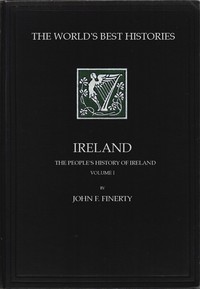
Ireland: The People's History of Ireland, Volume 1 (of 2) — A Reader’s Guide
(0 User reviews)
360
Project Gutenberg
2022
Not confirmed
Ireland -- History
Readers of public-domain and historical texts
Project Gutenberg digital edition
en
Edition facts
Words
133,807
Reading time
582 min
Text sections
80
This digital edition of Ireland: The People's History of Ireland, Volume 1 (of 2) — A Reader’s Guide is described by source-level measurements including 133,807 words, 9 hr 42 min estimated reading time, and 80 detected text sections.
The text analysis averages about 28.3 words per sentence, while the detected sections provide another way to judge how the source is divided.
Project Gutenberg metadata also associates the work with “Ireland -- History,” connecting these edition facts with the source record’s subject description.
Source:
Project Gutenberg record #67845
Finerty's 1904 narrative history of Ireland from ancient times to the 17th century, emphasizing oppression and resistance. The catalog subject 'Ireland -- History' is accurate, but the excerpts reveal a strong partisan voice and focus on Catholic suffering under English rule, not a neutral survey.
Editorial Edition Score
4.9/5
★★★★★
★★★★★
Calculated from edition completeness, EPUB availability, text structure and catalogue metadata. Not a user rating.
How this score is calculated
- Description quality20 pts
- Title & short description10 pts
- Source metadata20 pts
- Text length15 pts
- Chapters / structure15 pts
- EPUB file integrity20 pts
Total of 100 points, scaled to a 2.5-5.0 range. Editions with an empty description or a missing EPUB file are not scored.
Edition quality
Public-domain source text
Read the source text
The source text is kept in the dedicated reader, separate from this catalogue record and its commentary.
John F. Finerty, president of the United Irish League of America, wrote this two-volume history in 1904 with an explicit nationalist perspective. The catalog subject 'Ireland -- History' is accurate but understates the book's polemical character. Finerty does not pretend to impartiality; his preface frames the work as a corrective to English accounts. The excerpts show a narrative driven by moral outrage, particularly in descriptions of Cromwellian and post-Restoration policies.
Structure and Scope: From Myth to Cromwell
The table of contents reveals an ambitious sweep: Book I covers from 'Earliest Period' to the Reformation, Book II from the Reformation to the exile of Ulster princes under James I. The excerpts, however, jump to the Cromwellian period (1650s) and Charles II's reign, suggesting the full text extends further. Finerty organizes by reigns and invasions—Danish, Norman, Tudor—but the surviving sample emphasizes the 17th century, particularly the Cromwellian conquest. The narrative is episodic, with chapters on battles, laws, and persecutions. Notably, the excerpts include lengthy quotations from other historians (e.g., McGee), indicating Finerty synthesizes secondary sources rather than original documents. The structure is chronological but heavily weighted toward English misrule.
Voice and Rhetoric: The Language of Indignation
Finerty's prose is consistently emotive. He describes Cromwell's regime as 'a veritable counterpart of the infernal regions' and claims 'the curse of Cromwell remained with Ireland for many a black and bitter day.' The excerpts show a pattern of hyperbole: '100,000 souls' transported, 'three bishops and three hundred ecclesiastics' killed. These figures are presented without citation, though Finerty attributes some to 'some contemporary accounts' or to McGee. The language of victimhood is paired with religious framing—'outraged Irish fathers and mothers' praying for deliverance. The authorial voice is that of a partisan advocate, not a detached scholar. This rhetorical stance is consistent with the book's origin in the United Irish League, a nationalist organization.
Treatment of Sources and Evidence
Finerty relies heavily on a few named authorities, especially the Irish-Canadian historian Thomas D'Arcy McGee, whom he quotes at length. The excerpts include a block quotation from McGee describing the Cromwellian land distribution as 'nearly as complete as that of Canaan by the Israelites.' Finerty also references 'some contemporary accounts' for the transport of children, but does not name them. The book lacks footnotes or a bibliography in the excerpts. The author's method is to assemble dramatic quotations and statistics to support a predetermined narrative of oppression. Readers should be aware that the work is a secondary compilation, not a primary source, and that its evidence is filtered through a nationalist lens. The catalog subject 'Ireland -- History' is correct, but the book is best understood as a specimen of early 20th-century Irish-American nationalist historiography.
This volume offers a vivid, if one-sided, account of Irish history from a nationalist perspective. Readers interested in the development of Irish-American political thought will find it valuable, but those seeking a balanced history should supplement it with modern scholarship. The excerpts reveal a work driven by moral conviction rather than dispassionate analysis, making it a primary source for understanding how Irish grievances were memorialized in the early 1900s.
Reading Finerty’s account of old Irish grief, I found myself thinking of how another historian once traced the long, weary patience of English crowns. There is a quiet weight in each volume, a sense of centuries resting on the page. That older work—The History of England in Three Volumes, Vol.II. Continued from the Reign of William and Mary to the Death of George II. — Story, Setting & Ideas—feels like a companion in that slow, witnessing gaze.
There are no reviews for this eBook.
There are no comments for this eBook.
Reader reflection
How will you remember this book?
Save your reaction, strongest insight, and memorable passage.
Your progress
0
/
10
2
Was reading this book enjoyable?
3
How likely are you to recommend this book?
4
What was the reading difficulty like?
5
Did this book create an emotional response?
6
Is this a title worth rereading?
7
Could you follow the author’s main argument?
8
Did you relate to its people, ideas, or situations?
9
What changed or sharpened your thinking?
10