1

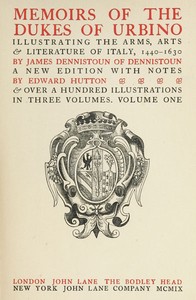
Memoirs of the Dukes of Urbino, Volume 1 (of 3) Illustrating the Arms, Arts, and Literature of Italy, from 1440 To 1630. — Story, Setting & Ideas
(0 User reviews)
1187
Project Gutenberg
2013
Not confirmed
Renaissance -- Italy; Urbino, Dukes of; Nobility -- Italy -- History; Urbino (Italy)
Readers of public-domain and historical texts
Project Gutenberg digital edition
en
Edition facts
Words
176,159
Reading time
766 min
Text sections
26
The catalog record for Memoirs of the Dukes of Urbino, Volume 1 (of 3) Illustrating the Arms, Arts, and Literature of Italy, from 1440 To 1630. — Story, Setting & Ideas provides practical reading context through 176,159 words, 12 hr 46 min estimated reading time, and 26 detected text sections.
The text analysis averages about 25.5 words per sentence, while the detected sections provide another way to judge how the source is divided.
Project Gutenberg metadata also associates the work with “Renaissance -- Italy,” connecting these edition facts with the source record’s subject description.
Source:
Project Gutenberg record #42560
James Dennistoun's 1851 study of the Urbino court, reissued with Edward Hutton's 1909 notes, uses archival sources and contemporary chronicles to trace the Montefeltro and della Rovere dukes. The opening volume covers Federigo da Montefeltro's military and cultural patronage, with detailed asides on figures like Caterina Sforza.
Editorial Edition Score
4.9/5
★★★★★
★★★★★
Calculated from edition completeness, EPUB availability, text structure and catalogue metadata. Not a user rating.
How this score is calculated
- Description quality20 pts
- Title & short description10 pts
- Source metadata20 pts
- Text length15 pts
- Chapters / structure15 pts
- EPUB file integrity20 pts
Total of 100 points, scaled to a 2.5-5.0 range. Editions with an empty description or a missing EPUB file are not scored.
Edition quality
Public-domain source text
Read the source text
The source text is kept in the dedicated reader, separate from this catalogue record and its commentary.
Edward Hutton's 1909 introduction frames James Dennistoun's Memoirs as 'the standard authority' for the Urbino court, a claim that the excerpts support through dense interweaving of political narrative and quoted primary sources. The work opens with a dedication to Edmund G. Gardner and a note on textual corrections—Piero della Francesca, Raffaele, Pinturicchio—signaling editorial care for accuracy. Dennistoun's method emerges in a passage on Caterina Sforza: he juxtaposes Fabio Oliva's florid description ('as if the sun had emerged') with Ratti's more measured praise, then adds his own observation that her features may survive in church donor portraits. This layered approach—chronicle, quotation, cautious inference—characterizes the volume.
A Nineteenth-Century Scholar's Renaissance
Dennistoun, a Scottish antiquary, wrote before the professionalization of history. His Memoirs blend narrative with lengthy excerpts from Giovanni Santi's rhyming chronicle, diplomatic dispatches, and local histories. The excerpt on the Tuscan war of 1478–79 shows him shifting from Italian politics to the Turkish threat: 'Sixtus was wasting in the Tuscan war those energies which, as head of the Church, he might have easily united against the victorious Crescent.' The moral judgment is explicit, the syntax balanced. Readers should expect a Victorian moral framework—popes are criticized, Venetian pragmatism noted—alongside genuine archival labor. Hutton's footnotes (marked by asterisks) occasionally update Dennistoun's claims, creating a dialogue across sixty years.
Caterina Sforza as a Test Case
The extended portrait of Caterina Sforza—'this siren of her times'—reveals Dennistoun's method and limits. He reproduces Oliva's ekphrasis ('Her hair, wreathed in the manner of a coronet, was brighter than the gold') and Ratti's encomium ('Endowed with a lofty and masculine spirit'), then adds a cautious note about her depiction in Marco Palmeggiani's altarpiece. He does not claim certainty; the phrase 'are supposed to have been commemorated' hedges. This section exemplifies how Dennistoun uses visual evidence (medallions, church pictures) as historical documents. For a first reader, it also shows the book's rhythm: a political event triggers a biographical digression, which then returns to the main narrative. The digressions are often the most vivid passages.
The Texture of Quotation and Commentary
Dennistoun's prose is thick with quotation marks. In the space of a few pages, he moves from Sanzi's hyperbolic comparison of Girolamo Riario to Jove, to Oliva's baroque description, to Ratti's summary, to his own observation about donor portraits. The effect is cumulative: the reader hears multiple voices—chronicler, biographer, modern editor—without losing Dennistoun's guiding hand. His own sentences tend toward the periodic: 'Possessed of ample means, and prodigal in their use, the ambition and political influence of Girolamo promised a long career of advancement and of coming glories for his subjects.' This style rewards slow reading. The editor's notes, visible in the transcriber's apparatus, correct spellings and identify sources, adding a layer of scholarly apparatus that the original 1851 edition lacked.
What the Excerpts Leave Unresolved
The provided excerpts break off during the Turkish wars and the Riario settlement, offering no conclusion to either thread. A first reader should note that Dennistoun's narrative is episodic: he follows the della Rovere popes, the Montefeltro dukes, and the Sforza connections across decades, but the excerpts give only fragments. The full volume likely returns to Federigo da Montefeltro's cultural patronage—the 'Arms, Arts, and Literature' of the subtitle—but the excerpts emphasize politics and war. Hutton's introduction promises that the book remains 'the standard authority,' yet the modern reader must weigh Dennistoun's Victorian biases against his evident erudition. The footnotes and corrected spellings (Piero della Francesca, not Pietro) hint at a text that has been carefully updated, but the core judgments are Dennistoun's own.
Approach this volume as a nineteenth-century collection of sources rather than a modern monograph. Dennistoun's value lies in the excerpts he preserves—from Santi's poem, from Oliva's biography, from diplomatic letters—and in his willingness to let his subjects speak at length. The editorial notes by Hutton and the transcriber's corrections (red underlining, pop-up transliterations for Greek) make the e-book more navigable than the 1851 original. Read for the set-pieces: Caterina Sforza's entrance, the Turkish raids on Friuli, the machinations of Sixtus IV. The narrative thread is there, but the real texture is in the quoted voices.
There’s something gentle about Dennistoun’s Urbino, the way he lingers on Federigo’s quiet patronage amid the noise of spears. It made me think of another shelf, where The historians' history of the world in twenty-five volumes, volume 08 — Themes and Context sits, old and full of almost-forgotten days. Both feel like letters from another century, read slowly, by lamplight.
There are no reviews for this eBook.
There are no comments for this eBook.
Reader reflection
How will you remember this book?
Save your reaction, strongest insight, and memorable passage.
Your progress
0
/
10
2
Did this book hold your interest?
3
Is this a title you would suggest to others?
4
How much effort did this book require?
5
Which aspect of the book did you value most?
6
How much did the book move you?
7
What did you think about the pace?
8
Did you relate to its people, ideas, or situations?
9
What did this book teach you most?
10