1

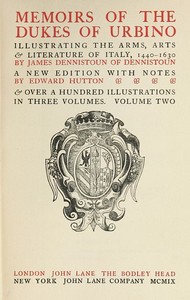
Memoirs of the Dukes of Urbino, Volume 2 (of 3) Illustrating the Arms, Arts, and Literature of Italy, from 1440 To 1630. — Reading Notes
(0 User reviews)
36
Project Gutenberg
2013
Not confirmed
Renaissance -- Italy; Urbino, Dukes of; Nobility -- Italy -- History; Urbino (Italy)
Readers of public-domain and historical texts
Project Gutenberg digital edition
en
Edition facts
Words
160,573
Reading time
699 min
Text sections
22
Memoirs of the Dukes of Urbino, Volume 2 (of 3) Illustrating the Arms, Arts, and Literature of Italy, from 1440 To 1630. — Reading Notes can be approached with a clearer sense of reading commitment from its source measurements: 160,573 words, 11 hr 39 min estimated reading time, and 22 detected text sections.
The text analysis averages about 26.3 words per sentence, while the detected sections provide another way to judge how the source is divided.
Project Gutenberg metadata also associates the work with “Renaissance -- Italy,” connecting these edition facts with the source record’s subject description.
Source:
Project Gutenberg record #44235
James Dennistoun's 1851 history of Urbino's dukes, focusing on Guidobaldo's restoration, the court's cultural zenith, and the patronage of arts and letters, with Edward Hutton's 1909 annotations.
Editorial Edition Score
4.9/5
★★★★★
★★★★★
Calculated from edition completeness, EPUB availability, text structure and catalogue metadata. Not a user rating.
How this score is calculated
- Description quality20 pts
- Title & short description10 pts
- Source metadata20 pts
- Text length15 pts
- Chapters / structure15 pts
- EPUB file integrity20 pts
Total of 100 points, scaled to a 2.5-5.0 range. Editions with an empty description or a missing EPUB file are not scored.
Edition quality
Public-domain source text
Read the source text
The source text is kept in the dedicated reader, separate from this catalogue record and its commentary.
Dennistoun's narrative in this second volume moves from the political turbulence of Cesare Borgia's fall to the cultural flowering of Urbino's court. The author's voice shifts between brisk chronicle of events—such as the massacre of Sinigaglia and the election of Julius II—and leisurely digressions on architecture, painting, and literature. A recurring structural pattern is the pairing of a duke's biography with a survey of the arts under his rule, as seen in Book Third's account of Guidobaldo and Book Fourth's treatment of literature and art. The prose is dense with proper names and Italian phrases, reflecting Dennistoun's antiquarian method, while Hutton's editorial notes occasionally clarify or correct the original.
Narrative Pace and Political Set-Pieces
The volume opens with a rapid sequence of events: the massacre of Sinigaglia, the death of Alexander VI, and Cesare Borgia's narrow escape. Dennistoun compresses these into short, chapter-length episodes, each driven by a clear cause-and-effect logic. The pace slows markedly when Guidobaldo is restored to power and the narrative turns to court ceremonies, such as his investiture as Knight of the Garter. A notable shift occurs in Chapter XXI, where the author pauses the political story to describe the court's manners and its 'stars'—a term he uses for the luminaries of Urbino's cultural circle. This alternation between swift action and static description is a deliberate compositional choice, signaling that Dennistoun values both event and atmosphere.
Voice and the Antiquarian's Judgment
Dennistoun frequently interjects personal assessments, often through qualifying phrases like 'we may, however, pardon the transmutation' or 'it was Bramante's misfortune.' These asides reveal a narrator who weighs historical outcomes against aesthetic or moral standards. His voice is that of a Victorian gentleman-scholar, comfortable with sweeping generalizations—'the slippery foundations that from time to time have occasioned infinite anxiety'—and with pointed critiques of papal ambition. The prose is formal but not stiff, occasionally rising to epigram: 'he was a poet, for in Italy all sentiment readily falls into rhyme.' Such remarks give the text a conversational intimacy, as if Dennistoun is guiding the reader through his own research notes.
Recurring Details: Architecture and Artistic Patronage
Throughout the volume, Dennistoun returns to architectural projects as markers of ducal ambition. The Vatican's Belvidere corridor, Bramante's unfinished designs, and the 'vast substructions' near S. Biagio are described with technical precision. He notes how successive popes altered earlier plans, a theme that echoes the political instability of the period. Artistic patronage is another constant: Duke Guidobaldo's court is praised for attracting figures like Emilia Pia, while later chapters list painters and architects—Perugino, Pinturicchio, Luca Signorelli—who frequented Bramante's table. These details are not merely catalogued; Dennistoun uses them to argue that Urbino's cultural legacy outlasted its political power.
Readers should attend to Dennistoun's footnotes and Hutton's bracketed additions, which often contain corrections or supplementary references. The volume's chronological table and list of illustrations are useful for navigating the dense web of names and events. Because the excerpts are incomplete, the overall arc of Guidobaldo's reign and the full scope of Book Fourth's survey remain partially obscured; treat Dennistoun's judgments as provisional, grounded in the evidence he presents rather than in modern scholarship.
The rain kept time against the window while I lingered over Dennistoun’s account of Guidobaldo’s court, that fragile brilliance of patronage. It made me think how dynasties fade but their libraries endure. Later, half-dreaming, I pulled down an old favorite, A Student's History of England, v. 1: B.C. 55-A.D. 1509 From the Earliest Times to the Death of King Edward VII — Key Ideas to Explore, and found the same quiet thread — power passing, stories staying.
There are no reviews for this eBook.
There are no comments for this eBook.
Reader reflection
What did you think of this book?
Answer a few questions and save a private reflection on this device.
Your progress
0
/
10
2
What was your overall reaction to the book?
3
How likely are you to recommend this book?
4
Did the language feel accessible?
5
Did this book create an emotional response?
6
How clear did the writing feel?
7
Did the book offer a fresh perspective?
8
How would you describe its reading pace?
9
Which lesson or insight stayed with you?
10