1

The archæology of Rome, Part 7 — Background and Themes
(0 User reviews)
1015
Project Gutenberg
2024
Not confirmed
Rome -- Antiquities
Readers of public-domain and historical texts
Project Gutenberg digital edition
en
Edition facts
Words
50,294
Reading time
219 min
Text sections
49
The catalog record for The archæology of Rome, Part 7 — Background and Themes provides practical reading context through 50,294 words, 3 hr 39 min estimated reading time, and 49 detected text sections.
The text analysis averages about 20.5 words per sentence, while the detected sections provide another way to judge how the source is divided.
Project Gutenberg metadata also associates the work with “Rome -- Antiquities,” connecting these edition facts with the source record’s subject description.
Source:
Project Gutenberg record #73751
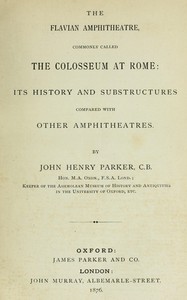
John Henry Parker's 1876 study of the Colosseum uses recent excavations to challenge long-held assumptions about the amphitheater's construction date and original form, focusing on the substructures beneath the arena floor.
Editorial Edition Score
4.9/5
★★★★★
★★★★★
Calculated from edition completeness, EPUB availability, text structure and catalogue metadata. Not a user rating.
How this score is calculated
- Description quality20 pts
- Title & short description10 pts
- Source metadata20 pts
- Text length15 pts
- Chapters / structure15 pts
- EPUB file integrity20 pts
Total of 100 points, scaled to a 2.5-5.0 range. Editions with an empty description or a missing EPUB file are not scored.
Edition quality
Public-domain source text
Read the source text
The source text is kept in the dedicated reader, separate from this catalogue record and its commentary.
John Henry Parker opens his 1876 monograph on the Colosseum by declaring that the great excavations of 1874–1875 have thrown an entirely new light on its history. He immediately challenges the received notion that the entire structure was built in ten years by the Flavian emperors, asserting that no ancient author says so and that the building was actually begun in the time of Sulla by his stepson Scaurus. Parker’s voice is combative and corrective, repeatedly dismissing what he calls “Roman Traditions” as mere conjectures of learned men from the last three centuries.
Excavation as Revelation
Parker’s argument rests on physical evidence uncovered below the arena floor. He reports that the original pavement was found 21 feet below the level that had been called the ground, floor, or arena. The space between was filled with walls, passages, dens for wild beasts, lifts for men and animals, and canals for water. He describes a boarded floor covered with sand—the arena proper—that could be moved and replaced quickly at the emperor’s command. Large corbels projecting from the wall below the podium served to store the boards out of sight. Parker’s language is precise and technical, but he also conveys a sense of discovery: “no one had any idea” of these arrangements before the excavations.
The Language of Doors and Staircases
Parker devotes careful attention to the names and functions of the amphitheater’s gates and passages. He discusses the Porta Libitinensis, through which the bodies of the killed were carried out on a special bier called a sandapila, citing Lampridius, Juvenal, and the old scholiast. He notes that the name is sometimes written sanavivaria in the Acta Martyrum Felicitatis et Perpetuae. He also tackles the puzzling term cochlea (literally “snail”), which commentators had struggled to explain. Parker identifies it as a medieval Latin term for a winding or newel staircase, pointing to two such staircases leading from the substructures to the arena level at the southeast end of the central passage. He supports this with the parallel of Trajan’s Column, frequently called columna cochlea because of its internal spiral staircase.
The Spectacle of the Games
Parker assembles a series of ancient testimonies to convey the intensity of Roman public amusements. He quotes Suetonius on Caligula’s all-day attendance and the people assembling at midnight for free shows; Claudius going to the amphitheater at daybreak to feed the wild beasts; and Petronius on two old negroes sprinkling the arena with scents from small bottles. Tacitus is cited for his own account of the secular games under Claudius. Parker’s method is to let the ancient authors speak, but he frames their words with a modern sense of wonder: “The importance attached to the public amusements, both by the people and by the emperors, appears extraordinary to modern ideas.” The pace here shifts from archaeological description to a more anecdotal, almost ethnographic mode.
Parker’s work is best read as a polemical intervention in a long-running scholarly debate. He writes with the authority of a museum keeper who has examined the fabric of the building firsthand, and his footnotes bristle with references to classical texts and earlier commentators. Readers should attend to the way he uses architectural detail—corbels, staircases, gate names—as evidence for a revised chronology, and to his habit of dismissing received opinion as mere tradition. The book rewards those who follow his arguments closely, even where the evidence is fragmentary.
I remember how Parker’s spade, clawing beneath the Colosseum’s sand, found older stones than Rome had claimed—buried truths, quietly patient. It made me think of another city’s buried layers, where the old capital whispers beneath a newer sky. That same tender archaeology of memory fills Constantinople: The Story of the Old Capital of the Empire — Context and Discussion, each brick a kept secret, each foundation a lingering heartbeat. Strange, how two distant places can share one hushed, enduring soul.
There are no reviews for this eBook.
There are no comments for this eBook.
Reader reflection
Your personal reading reflection
Build a private reading journal entry for this title.
Your progress
0
/
10
2
What was your overall reaction to the book?
3
Would you pass this book on to a friend?
4
How much effort did this book require?
5
Was the book moving at the right speed?
6
Which element worked best for you?
7
Did it raise ideas you would like to talk about?
8
Was the book what you thought it would be?
9
What did this book teach you most?
10