1

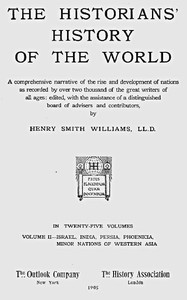
The historians' history of the world in twenty-five volumes, volume 02 — Inside the Classic
(0 User reviews)
1073
Project Gutenberg
2016
Not confirmed
World history
Readers of public-domain and historical texts
Project Gutenberg digital edition
en
Edition facts
Words
376,909
Reading time
1639 min
Text sections
45
The catalog record for The historians' history of the world in twenty-five volumes, volume 02 — Inside the Classic provides practical reading context through 376,909 words, 27 hr 19 min estimated reading time, and 45 detected text sections.
The text analysis averages about 23.5 words per sentence, while the detected sections provide another way to judge how the source is divided.
Project Gutenberg metadata also associates the work with “World history,” connecting these edition facts with the source record’s subject description.
Source:
Project Gutenberg record #52177
This volume compiles ancient historians' accounts of Israel, India, Persia, Phoenicia, and minor Western Asian nations. Editor Henry Smith Williams juxtaposes diverse voices, from biblical narrative to classical authors, revealing how each source shapes its history through distinct rhetorical strategies and evidentiary choices.
Editorial Edition Score
4.9/5
★★★★★
★★★★★
Calculated from edition completeness, EPUB availability, text structure and catalogue metadata. Not a user rating.
How this score is calculated
- Description quality20 pts
- Title & short description10 pts
- Source metadata20 pts
- Text length15 pts
- Chapters / structure15 pts
- EPUB file integrity20 pts
Total of 100 points, scaled to a 2.5-5.0 range. Editions with an empty description or a missing EPUB file are not scored.
Edition quality
Public-domain source text
Read the source text
The source text is kept in the dedicated reader, separate from this catalogue record and its commentary.
The second volume of The Historians' History of the World presents a mosaic of ancient civilizations—Israel, India, Persia, Phoenicia, and the minor nations of Western Asia—through the eyes of over two thousand writers. Editor Henry Smith Williams orchestrates a chorus of voices that range from the biblical chroniclers to Greek and Roman historians, each bringing a distinct narrative style and evidentiary approach. The volume does not attempt a single, unified story; instead, it foregrounds the act of historical writing itself, showing how different cultures and eras frame their pasts.
Readers encounter abrupt shifts in pace and perspective: the dense, theological prose of Hebrew scripture gives way to the ethnographic observations of Herodotus, then to the pragmatic military accounts of later authors. This editorial design invites scrutiny of how historical truth is constructed, contested, and reshaped across time.
Biblical Narrative and Its Editorial Framing
The Israelite section draws heavily on the Old Testament, but the editor interleaves critical commentary from nineteenth-century scholars such as Bernhard Stade. The result is a layered text where the patriarchal stories are presented alongside source-critical observations. For instance, the account of the Egyptian sojourn is followed by a note on the documentary hypothesis, alerting readers to the composite nature of the biblical text. This technique slows the narrative pace, forcing a reflective pause. The editor’s voice intrudes with phrases like “according to the biblical account,” signaling distance from the source material. The effect is a history that is both reverent and skeptical, a balancing act that characterizes the volume’s treatment of sacred history.
Classical Voices on Persia and Phoenicia
When the focus shifts to Persia and Phoenicia, the sources become predominantly Greek and Roman. Herodotus provides vivid, anecdotal accounts of Persian customs and the rise of Cyrus, while Diodorus Siculus offers a more systematic description of Phoenician commerce and colonization. The editor selects passages that highlight the Greeks’ fascination with the “other”—Persian luxury, Phoenician maritime skill—but also includes critical asides. For example, a note questions Diodorus’s claim about the fate of Spanish mine workers, suggesting it may reflect Roman rather than Phoenician practice. These editorial interventions create a dialogue between ancient and modern perspectives, quickening the pace as the reader moves from narrative to analysis. The volume thus becomes a meta-history, examining how classical authors shaped Western perceptions of the East.
The Editor’s Hand: Annotations and Omissions
Throughout the volume, Williams inserts footnotes, bracketed comments, and introductory essays that guide interpretation. These paratextual elements vary in length and tone: some are terse clarifications of obscure references; others are extended critiques of source reliability. For instance, a footnote on the Book of Job’s allusion to mining notes the uncertainty of its connection to Phoenicia, demonstrating the editor’s caution. At the same time, the volume omits entire sections of some sources—Herodotus’s digressions on Egyptian customs, for example—to maintain thematic focus. This selective curation means the reader is always aware of a mediating intelligence. The editorial voice, though authoritative, occasionally reveals its own biases, as when it dismisses certain biblical chronology as “legendary.” The result is a history that is as much about the historian as about the past.
This volume rewards readers who attend to its editorial apparatus as much as its primary texts. The juxtaposition of sacred and secular sources, the shifting narrative speeds, and the persistent framing by nineteenth-century scholarship all invite a critical engagement with the nature of historical evidence. Rather than a straightforward chronicle, it offers a lesson in how history is assembled, questioned, and retold. For those interested in the historiography of the ancient world, it remains a valuable case study in editorial practice.
There’s something humbling about watching ancient writers shape whole nations from their own assumptions, each voice a kind of quiet architecture. It made me think of Prescott’s patient, rueful observations on Peru, how conquest always arrives with its own self-justifications already written. That older volume stays with me, too. History of the Conquest of Peru — Edition Insights feels like a familiar hand on a well-worn shelf, waiting for a rainy afternoon when I might finally return to it. A small comfort, really.
There are no reviews for this eBook.
There are no comments for this eBook.
Reader reflection
How did this book work for you?
Your answers remain private and are stored only in this browser.
Your progress
0
/
10
2
What was your overall reaction to the book?
3
Would you pass this book on to a friend?
4
Did the language feel accessible?
5
Would you read this book again?
6
Did the book deliver what you hoped for?
7
Did the book give you something worth debating?
8
Did anything about the book feel genuinely new?
9
Which lesson or insight stayed with you?
10