1

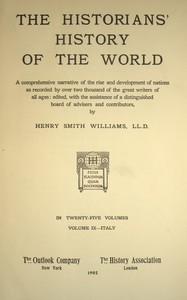
The historians' history of the world in twenty-five volumes, volume 09 — Context and Discussion
(0 User reviews)
84
Project Gutenberg
2023
Not confirmed
World history
Readers of public-domain and historical texts
Project Gutenberg digital edition
en
Edition facts
Words
390,859
Reading time
1700 min
Text sections
65
The catalog record for The historians' history of the world in twenty-five volumes, volume 09 — Context and Discussion provides practical reading context through 390,859 words, 28 hr 20 min estimated reading time, and 65 detected text sections.
The text analysis averages about 27.9 words per sentence, while the detected sections provide another way to judge how the source is divided.
Project Gutenberg metadata also associates the work with “World history,” connecting these edition facts with the source record’s subject description.
Source:
Project Gutenberg record #71209
This volume compiles excerpts from historians like Machiavelli and Guicciardini to narrate Italian history. The editor's choices in diction and structure reveal how chroniclers shaped accounts of political upheaval, as seen in the vivid, almost theatrical description of Michele di Lando's rise during the Florentine tumult.
Editorial Edition Score
4.9/5
★★★★★
★★★★★
Calculated from edition completeness, EPUB availability, text structure and catalogue metadata. Not a user rating.
How this score is calculated
- Description quality20 pts
- Title & short description10 pts
- Source metadata20 pts
- Text length15 pts
- Chapters / structure15 pts
- EPUB file integrity20 pts
Total of 100 points, scaled to a 2.5-5.0 range. Editions with an empty description or a missing EPUB file are not scored.
Edition quality
Public-domain source text
Read the source text
The source text is kept in the dedicated reader, separate from this catalogue record and its commentary.
This volume of The Historians’ History of the World presents Italian history through a mosaic of excerpts from chroniclers such as Machiavelli, Guicciardini, and Sismondi. The editor, Henry Smith Williams, selects passages that foreground dramatic political action and the raw mechanics of power. One striking example is the account of Michele di Lando, a wool-comber who seizes control of Florence during a plebeian revolt. The narrative dwells on physical details—barefoot, with scarcely anything upon him—and on the swift, brutal justice of a gallows erected in the palace court. Such choices in diction and focus reveal how the original historians shaped their stories, emphasizing the volatility of popular rule and the personal qualities of leaders.
Diction of Power and Tumult
The excerpt describing the Florentine uprising relies on a vocabulary of immediacy and violence. Words like tumultuously, rage, and barefoot create a sense of raw, unmediated action. The editor’s selection highlights moments where the chronicler’s language mirrors the chaos: the plebeians enter the palace with the standard of the gonfalonier, and Michele di Lando is described as “more favoured by nature than by fortune.” This phrasing, typical of Machiavelli’s style, contrasts innate sagacity with luck, a recurring theme in Renaissance political writing. The editor’s choice to include such passages underscores how historians used pointed diction to moralize about leadership and popular will.
Structure as Commentary
The arrangement of the excerpt—moving from the seigniory’s fear to Michele’s decisive actions—creates a narrative arc that implicitly judges the events. The editor preserves the original historians’ structural choices: the scene opens with dissension among the rulers, then shifts to the plebeians’ takeover, and finally details Michele’s reforms. This sequence emphasizes the fragility of established authority and the speed with which order can be overturned. The inclusion of the gallows and the tearing apart of Ser Nuto serves as a structural pivot, marking the transition from chaos to a new, brutal order. By retaining such structural elements, the volume allows readers to see how historians shaped their accounts to convey political lessons.
Dialogue and Direct Speech
Direct speech is used sparingly but effectively in the excerpt. Michele di Lando’s question to the multitude—“You see this palace is now yours, and the city is in your power; what do you think ought to be done?”—is a rare moment of reported dialogue. The editor’s inclusion of this line highlights how historians used speech to characterize leaders as pragmatic or theatrical. The crowd’s reply, that they would have him for their gonfalonier and lord, is given without embellishment, suggesting a transactional relationship. Elsewhere, the text reports that Michele “resolved to compose the tumult and restore peace,” but his words are not given. This asymmetry in dialogue—abundant for some figures, absent for others—reflects the chroniclers’ focus on action over oratory, a choice the editor preserves.
Recurring Details of Setting and Symbolism
The physical setting of the palace court recurs as a stage for power shifts. The gallows erected there, the burning of balloting purses, and the tearing of Ser Nuto’s body are all described with precise, almost clinical detail. These recurring elements—public space, symbols of justice, and violent spectacle—serve as motifs that the editor’s selection emphasizes. The palace is not just a building but a contested symbol: first held by the seigniory, then by the plebeians, then by Michele. The editor’s choice to include the detail that Michele “burned the balloting purses” points to a recurring concern with legitimacy and the material tokens of governance. Such details, drawn from multiple chroniclers, create a cohesive picture of how Italian city-states experienced political crisis.
Readers approaching this volume should attend to the editorial hand that selects and arranges these excerpts. The juxtaposition of different historians—Machiavelli’s terse analysis alongside Guicciardini’s fuller narrative—reveals competing interpretations of the same events. By focusing on diction, structure, dialogue, and setting, one can trace how these chroniclers constructed their histories not as neutral records but as arguments about power, virtue, and fate. This volume offers a chance to compare those arguments directly.
I keep thinking about how Machiavelli’s careful shaping of di Lando’s moment makes it feel almost staged—until I remember the quiet unease I felt reading The Romanization of Roman Britain — A Reader’s Guide, where the conquest’s neat narrative likewise hides so many small, unrecorded losses. Both books leave me listening for the voices history chose not to amplify.
There are no reviews for this eBook.
There are no comments for this eBook.
Reader reflection
Your personal reading reflection
Build a private reading journal entry for this title.
Your progress
0
/
10
2
How did the book work for you overall?
3
Would you recommend this book to another reader?
4
How demanding did the text feel?
5
Would you read this book again?
6
How much did the book move you?
7
How clear did the writing feel?
8
How original did the book feel?
9
Which lesson or insight stayed with you?
10