1

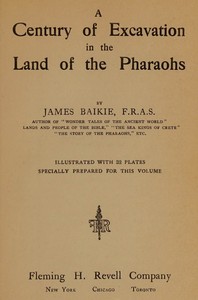
A century of excavation in the land of the Pharaohs — Text and Context
(0 User reviews)
146
Project Gutenberg
2025
Not confirmed
Egypt -- Antiquities; Excavations (Archaeology) -- Egypt
Readers of public-domain and historical texts
Project Gutenberg digital edition
en
Edition facts
Words
70,006
Reading time
305 min
Text sections
20
A century of excavation in the land of the Pharaohs — Text and Context can be approached with a clearer sense of reading commitment from its source measurements: 70,006 words, 5 hr 5 min estimated reading time, and 20 detected text sections.
The text analysis averages about 35.9 words per sentence, while the detected sections provide another way to judge how the source is divided.
Project Gutenberg metadata also associates the work with “Egypt -- Antiquities,” connecting these edition facts with the source record’s subject description.
Source:
Project Gutenberg record #75684
Baikie's 1924 survey of Egyptian excavation focuses on royal tombs, especially Abydos and Thebes, arguing that scientific archaeology is preferable to looting. The preface sets a modest scope, omitting city searches and papyrus hunting.
Editorial Edition Score
4.9/5
★★★★★
★★★★★
Calculated from edition completeness, EPUB availability, text structure and catalogue metadata. Not a user rating.
How this score is calculated
- Description quality20 pts
- Title & short description10 pts
- Source metadata20 pts
- Text length15 pts
- Chapters / structure15 pts
- EPUB file integrity20 pts
Total of 100 points, scaled to a 2.5-5.0 range. Editions with an empty description or a missing EPUB file are not scored.
Edition quality
Public-domain source text
Read the source text
The source text is kept in the dedicated reader, separate from this catalogue record and its commentary.
Baikie opens his preface by noting that no adequate account of excavation work in Egypt had been written, despite public interest. He modestly disclaims expertise, stating his volume only outlines certain aspects of the discoveries that restored ancient Egyptian civilization. He explicitly omits the Search for the Cities and papyrus hunting, the former because many 1890s identifications are now questioned, the latter because it has become too specialized. This self-imposed limitation shapes the book's focus on tomb excavation, particularly royal burials.
The Case for Scientific Excavation
Baikie confronts the ethical question of disturbing royal tombs. He argues that tomb robbery has been inevitable since ancient times—citing the fate of King Sebek-em-saf—and that the only choice is between looting by ignorant fellahin for private gain and orderly, scientific excavation that preserves historical context. He insists that denying science the opportunity to investigate tombs does not protect them; it only ensures knowledge is lost. This pragmatic defense frames the entire narrative, justifying the work of explorers as a necessary alternative to centuries of plunder.
The Wealth of Funerary Equipment
The excerpts describe the evolution of Egyptian funerary equipment from earliest times to the New Empire, culminating in the Theban tombs with their rock-hewn chambers, gilded coffins, amulets, illuminated papyri, and ushabtis. Baikie notes that this splendor, revealed most famously in Tutankhamen's tomb, may have actually invited robbery. The description emphasizes the paradox: the more elaborate the tomb, the greater the target. This observation ties the material culture directly to the central theme of preservation versus plunder.
Abydos and the Royal Tombs
The narrative begins the story of royal tombs with the excavation of Abydos, the sacred city of Osiris. Baikie presents this as the starting point, though he acknowledges it is not the earliest discovery chronologically. The choice of Abydos signals the book's focus on religiously significant sites. The excerpts do not reveal what was found there, but the preface's omission of city searches suggests that the book concentrates on tomb complexes rather than settlement archaeology.
Limitations and Scope
Baikie explicitly states two major omissions: the Search for the Cities (1890s identifications now questioned) and papyrus hunting (too specialized). This candor helps readers understand the book's selective coverage. The preface also notes that the volume is not a comprehensive history but an outline of certain aspects. Readers should expect a focus on royal tomb excavations, with less attention to everyday life or textual discoveries. The author's background as a popularizer (author of works on ancient Crete and biblical lands) suggests an accessible style aimed at the educated public.
The Role of the Reader
Baikie addresses the reader as a potential supporter of excavation, noting that public resources depend on interest. He does not assume prior knowledge but provides enough context to follow the discoveries. The excerpts show a clear argumentative thread: the necessity of scientific archaeology. Readers are encouraged to view the finds not as loot but as contributions to human knowledge. The book thus serves both as a history and as a justification for continued exploration.
Baikie's narrative is shaped by his explicit choices of what to include and omit. Readers will find a focused account of royal tomb excavations, with a strong argument for their scientific value. The book does not cover settlement archaeology or papyri, but offers a coherent story of how Egypt's buried past was recovered—and why that recovery matters.
Baikie’s old volume sits beside me, its measured pride in careful digging a quiet echo of how the Historians’ history once weighed civilizations with the same patient hand. Both prefer the slow sifting to the hurried grab, and I’ve often found their kinship in a shared respect for what the ground and the page keep. The historians' history of the world in twenty-five volumes, volume 09 — Context and Discussion feels like an afternoon conversation with that same dear, dusty companion.
There are no reviews for this eBook.
There are no comments for this eBook.
Reader reflection
What did you think of this book?
Answer a few questions and save a private reflection on this device.
Your progress
0
/
10
2
Was reading this book enjoyable?
3
Would you pass this book on to a friend?
4
What was the reading difficulty like?
5
How personally connected did you feel to the book?
6
How clear did the writing feel?
7
How useful were the ideas in this book?
8
Would a second reading be valuable?
9
In one sentence, what did you learn?
10