1

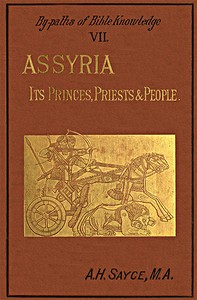
Assyria — Context and Discussion
(0 User reviews)
967
Project Gutenberg
2013
Not confirmed
Assyria -- History
Readers of public-domain and historical texts
Project Gutenberg digital edition
en
Edition facts
Words
42,617
Reading time
186 min
Text sections
6
For Assyria — Context and Discussion, the stored edition analysis reports 42,617 words, 3 hr 6 min estimated reading time, and 6 detected text sections.
The text analysis averages about 23.5 words per sentence, while the detected sections provide another way to judge how the source is divided.
Project Gutenberg metadata also associates the work with “Assyria -- History,” connecting these edition facts with the source record’s subject description.
Source:
Project Gutenberg record #42033
A. H. Sayce's 1885 study examines Assyrian history, religion, art, and daily life through recovered monuments and cuneiform tablets, focusing on the library of Nineveh and the scribal culture that preserved ancient texts.
Editorial Edition Score
4.7/5
★★★★★
★★★★★
Calculated from edition completeness, EPUB availability, text structure and catalogue metadata. Not a user rating.
How this score is calculated
- Description quality20 pts
- Title & short description10 pts
- Source metadata20 pts
- Text length15 pts
- Chapters / structure15 pts
- EPUB file integrity20 pts
Total of 100 points, scaled to a 2.5-5.0 range. Editions with an empty description or a missing EPUB file are not scored.
Edition quality
Public-domain source text
Read the source text
The source text is kept in the dedicated reader, separate from this catalogue record and its commentary.
Sayce opens his study by noting that the recovery and decipherment of Nineveh's monuments is 'one of the most wonderful achievements of the present century.' The work is structured as a series of thematic chapters—Country and People, History, Religion, Art and Literature, Manners and Customs—each drawing on recently excavated clay tablets and stone inscriptions. Rather than narrating a continuous story, Sayce moves between topics, using physical artifacts as anchors. The recurring image of the buried city 'sleeping beneath the fragments of its own ruins' sets a tone of archaeological revelation.
From Ruins to Records
The preface establishes a key structural pattern: Sayce contrasts the lost, mythologized Nineveh of classical writers with the tangible evidence now emerging from the ground. He describes how scholars once 'wrote long treatises to reconcile the statements of Greek historians with those of Scripture,' only to be contradicted by the next writer. The monuments, he implies, settle these debates. This movement between textual tradition and material proof recurs throughout the book. In the chapter on literature, for instance, Sayce shifts from describing the physical clay tablets—their size, baking process, and minute characters—to the scribes who copied them. He notes that tablets were 'thoroughly baked in a kiln, holes being drilled through them here and there to allow the steam to escape,' a detail that grounds the intellectual work in a craft process.
The Library as a Living Workshop
Sayce devotes considerable attention to the library of Nineveh, describing it not as a static collection but as a site of active production. He writes that 'a whole army of scribes was employed in it, busily engaged in writing and editing old texts.' The colophons of King Assur-bani-pal are quoted to show how the king claimed divine aid for his scribal project: 'Nebo and Tasmit had given him broad ears and enlightened his eyes so as to see the engraved characters.' This emphasis on the physical act of seeing and copying reinforces the book's interest in the material conditions of knowledge. Sayce also mentions a magnifying lens of crystal discovered by Layard, which he suggests was used for reading the tiny script—a concrete link between tool and text.
Lexicons and Lists: The Shape of Assyrian Learning
A significant portion of the literature Sayce describes is lexical and grammatical. He explains that scribes compiled 'syllabaries' listing cuneiform characters with their Accadian pronunciation and Assyrian translation, as well as tables of words for animals, birds, stones, and medicines. These lists were 'of the greatest possible assistance in the decipherment of the inscriptions.' Sayce's own narrative mirrors this cataloging impulse: he moves systematically through categories of knowledge, from religion to art to government. The structure of the book thus echoes the organizational principles of the Assyrian libraries it describes. Readers encounter not a linear history but a series of inventories, each section building a composite picture through accumulated detail.
Stone and Clay: The Two Materials of Record
Throughout the excerpts, Sayce distinguishes between inscriptions on stone and those on clay. Stone inscriptions, he notes, were 'engraved in florid characters, abounding in a multiplicity of needless wedges, and reminding us of our modern black-letter.' Clay tablets, by contrast, were smaller and more practical, baked in kilns to preserve them. This material contrast shapes the book's treatment of evidence: stone monuments provide public, ceremonial texts, while clay tablets contain the everyday literature of law, letters, and learning. Sayce's own text moves between these registers, discussing both the grand monoliths illustrated in the frontispiece and the humble 'fragment now in the British Museum showing primitive Hieroglyphics and Cuneiform Characters side by side.' The interplay of media becomes a structural motif.
Sayce's work is best approached as a guided tour of a newly opened archive. The reader should expect shifts between broad historical summary and close description of individual artifacts. Pay attention to the physical details—the size of tablets, the tools used to inscribe them, the libraries that housed them—as these are the threads that connect the book's disparate sections. The chronological table and biblical date list at the front provide a useful reference, but the real interest lies in watching Sayce assemble his evidence from fragments.
I remember sitting with Assyria and feeling the strange intimacy of those scribes copying tablets, their careful hands reaching toward me across centuries. It reminded me of another quiet afternoon, when a different book sketched the private lives behind public portraits—the same tender ache of touching distant minds. Historical Characters in the Reign of Queen Anne — Key Ideas to Explore held that same hush, as if voices lingered in the margins.
There are no reviews for this eBook.
There are no comments for this eBook.
Reader reflection
How did this book work for you?
Your answers remain private and are stored only in this browser.
Your progress
0
/
10
2
Was reading this book enjoyable?
3
Would you encourage someone else to read it?
4
How demanding did the text feel?
5
Was the book easy to understand?
6
Did this book create an emotional response?
7
How did the pace of the book feel?
8
Would you start a conversation about this book?
9
In one sentence, what did you learn?
10