1

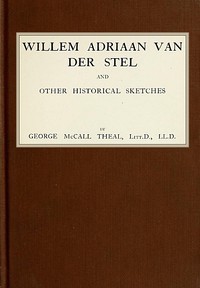
Willem Adriaan Van Der Stel, and Other Historical Sketches — Context and Discussion
(0 User reviews)
1834
Project Gutenberg
2017
Not confirmed
Netherlands -- History -- Eighty Years' War, 1568-1648; Stel, Willem Adriaan van der, 1664-1733; Cape of Good Hope (South Africa) -- History; South Africa -- History -- Great Trek, 1836-1840
Readers of public-domain and historical texts
Project Gutenberg digital edition
en
Edition facts
Words
114,989
Reading time
500 min
Text sections
18
Before opening Willem Adriaan Van Der Stel, and Other Historical Sketches — Context and Discussion, the edition data offers a quick orientation: 114,989 words, 8 hr 20 min estimated reading time, and 18 detected text sections.
The text analysis averages about 29.3 words per sentence, while the detected sections provide another way to judge how the source is divided.
Project Gutenberg metadata also associates the work with “Netherlands -- History -- Eighty Years' War, 1568-1648,” connecting these edition facts with the source record’s subject description.
Source:
Project Gutenberg record #55781
Theal's 1913 collection examines Portuguese exploration, the Dutch Revolt, and Cape Colony governance under Willem Adriaan van der Stel, contrasting early settlement conditions with later corruption, using archival detail and a moralizing tone.
Editorial Edition Score
4.8/5
★★★★★
★★★★★
Calculated from edition completeness, EPUB availability, text structure and catalogue metadata. Not a user rating.
How this score is calculated
- Description quality20 pts
- Title & short description10 pts
- Source metadata20 pts
- Text length15 pts
- Chapters / structure15 pts
- EPUB file integrity20 pts
Total of 100 points, scaled to a 2.5-5.0 range. Editions with an empty description or a missing EPUB file are not scored.
Edition quality
Public-domain source text
Read the source text
The source text is kept in the dedicated reader, separate from this catalogue record and its commentary.
Theal opens with a sweeping claim: the Portuguese discovery of a sea route to India was 'one of the greatest events in the history of the world,' affecting every state in Central and Western Europe. He immediately ties this to a geopolitical counterfactual—if the Turks had monopolized Indian trade, they might have taken Vienna in 1529. This framing reveals Theal's method: he treats colonial expansion as a hinge of European destiny, and his narrative voice is confident, moralizing, and attentive to economic and military pressures. The excerpts show him weaving together trade routes, Venetian intermediaries, and Mameluke Egypt into a causal chain that leads to the Cape.
A Governor's Reputation Before and After
Theal insists that Willem Adriaan van der Stel 'had borne a good character' before becoming governor, citing his decade as an Amsterdam official and the favor of East India Company directors who knew him personally. The author then quotes a Dutch proverb—De gelegenheid dieven en moordenaars maakt (Opportunity makes thieves and murderers)—to frame the governor's later infamy as a product of circumstance rather than innate vice. This is a striking rhetorical move: Theal does not simply condemn van der Stel but treats his corruption as a case study in how power transforms character. The evidence for this claim rests on the author's assertion that van der Stel's earlier conduct was outwardly upright, though no specific documents are cited in the excerpt. Readers should note that Theal's argument depends on this contrast between Amsterdam propriety and Cape malfeasance, a pattern he reinforces throughout the sketch.
Settlement Life and Material Culture
Theal provides a detailed inventory of the Cape settlement under van der Stel: wheatfields, vineyards, thatched cottages, and young oaks. He notes that 'concord was wanting' between Dutch and French colonists, and that the Dutch Reformed Church was the only tolerated public worship, though private devotion was free. The description of farming utensils is particularly vivid—the plough 'with but one stilt, being as clumsy as it well could be.' He also observes that coffins were stored in lofts, used as receptacles for odds and ends until needed. These material details serve a dual purpose: they evoke a frontier society of modest means, and they implicitly contrast the settlers' simplicity with van der Stel's later abuses. Theal's eye for the concrete—coffins, ploughs, thatched roofs—gives his narrative a documentary texture that distinguishes it from abstract political history.
The Structure of Historical Causation
Theal organizes his material into four sketches, each divided into numbered sections with synoptical indexes. The first sketch traces Portuguese exploration from Prince Henry to the Cape; the second covers the Dutch Revolt and maritime war with Spain; the third focuses on van der Stel's governorship; the fourth follows two leaders of the Great Trek, Louis Triegard and Pieter Uys. This structure implies a causal arc: European expansion creates colonial institutions, which generate local conflicts, which in turn produce emigration. Theal's prose is dense with proper names, dates, and legislative details, but he also pauses for moral commentary—for instance, noting that Huguenot refugees were 'located in the lovely valleys where so many of their descendants still reside.' The combination of archival specificity and narrative judgment is the book's hallmark, and readers should expect each section to balance factual recitation with interpretive asides.
Theal's sketches are best approached as a series of linked essays rather than a continuous narrative. Readers will benefit from consulting the synoptical index to track recurring figures and themes across sections. Pay attention to the author's use of proverbs and counterfactuals—they signal his interpretive stance. The material on daily life in the Cape settlement offers a counterpoint to the political intrigue, grounding the story in ploughs and coffins rather than just edicts and complaints.
There’s something about van der Stel’s story—how power quietly curdles—that stayed with me long after I closed the book. It reminded me of wandering through The historians' history of the world in twenty-five volumes, volume 02 — Inside the Classic, where the same human frailties echo across different centuries. That lingering ache of watching good intentions harden into corruption feels achingly familiar there too.
There are no reviews for this eBook.
There are no comments for this eBook.
Reader reflection
What did you think of this book?
Answer a few questions and save a private reflection on this device.
Your progress
0
/
10
2
How did the book work for you overall?
3
How likely are you to recommend this book?
4
Did the language feel accessible?
5
Would you start a conversation about this book?
6
How would you rate its originality?
7
Is this a title worth rereading?
8
What did you appreciate most?
9
What did this book teach you most?
10