1

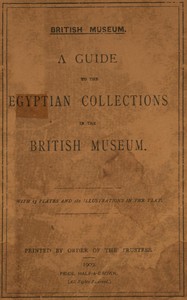
A guide to the Egyptian collections in the British Museum — Background and Themes
(0 User reviews)
143
Project Gutenberg
2025
Not confirmed
Egypt -- Antiquities
Readers of public-domain and historical texts
Project Gutenberg digital edition
en
Edition facts
Words
103,188
Reading time
449 min
Text sections
29
Before opening A guide to the Egyptian collections in the British Museum — Background and Themes, the edition data offers a quick orientation: 103,188 words, 7 hr 29 min estimated reading time, and 29 detected text sections.
The text analysis averages about 22.0 words per sentence, while the detected sections provide another way to judge how the source is divided.
Project Gutenberg metadata also associates the work with “Egypt -- Antiquities,” connecting these edition facts with the source record’s subject description.
Source:
Project Gutenberg record #76000
This editorial note examines how the opening, middle, and later excerpts of Budge's 1909 guide orient a first-time reader to the British Museum's Egyptian collections, focusing on the preface's scope, the detailed tomb equipment lists, and the shift to specific object descriptions.
Editorial Edition Score
4.9/5
★★★★★
★★★★★
Calculated from edition completeness, EPUB availability, text structure and catalogue metadata. Not a user rating.
How this score is calculated
- Description quality20 pts
- Title & short description10 pts
- Source metadata20 pts
- Text length15 pts
- Chapters / structure15 pts
- EPUB file integrity20 pts
Total of 100 points, scaled to a 2.5-5.0 range. Editions with an empty description or a missing EPUB file are not scored.
Edition quality
Public-domain source text
Read the source text
The source text is kept in the dedicated reader, separate from this catalogue record and its commentary.
The preface by E. A. Wallis Budge immediately establishes the guide's dual purpose: to provide general information for visitors while also sketching the origins, customs, language, writing, religion, and burial rites of ancient Egypt. Budge notes the collection comprises nearly fifty thousand objects, spanning from the Predynastic Period (about 4500 BC) to the fall of the Candace queens at Meroë in the second or third century AD. This sweeping chronological frame, combined with the promise of abundant illustrations, sets expectations for a work that balances overview with specific references to objects in the museum's rooms.
The Preface as a Roadmap
The preface, dated September 29, 1908, explicitly states that the guide is meant to supplement the more detailed room-specific guides. Budge writes that an attempt has been made to present a sketch of the origin, manners, customs, language, writing, literature, religion, and burial rites of the Egyptian peoples, with references to objects illustrating each branch. This framing tells the reader that the book is organized thematically rather than strictly by gallery layout. The preface also lists the collection's scope from the Predynastic Period to Christian Egypt (Coptic art between the sixth and eleventh centuries AD), signaling that the guide covers both pharaonic and later periods. A first-time reader should note that the preface does not detail every room but instead provides a conceptual map for navigating the subsequent chapters.
Tomb Equipment: A Window into Daily Life
One of the most concrete sections in the excerpts describes the ten categories of objects typically placed in tombs. These range from mummies and coffins to canopic jars, religious texts (such as the Book of the Dead), vessels for unguents, toilet boxes, pillows, furniture, and personal ornaments. The text specifies that the oldest vessels date from the Archaic Period and continue to the XXVIth dynasty, and that examples are located in the Third and Fourth Egyptian Rooms. This list is not merely a catalog; it reveals how the guide uses material culture to illustrate beliefs about the afterlife. For instance, the inclusion of sistrums, cymbals, and bells for priestesses, or bows and arrows for hunters, shows that the tomb equipment reflected the deceased's profession. The reader gains insight into Egyptian funerary practices through the arrangement of objects in the museum.
Personal Ornaments and Amulets
The excerpts devote considerable attention to personal ornaments, describing amulets worn for decorative and magical purposes, necklaces made of gold, amethyst, garnet, carnelian, and other materials believed to possess magical properties. The text notes that pendants were intended to bring luck, long life, and health. Specific cases are cited: Case F in the Fourth Egyptian Room contains amulets on one side and necklaces from between 1700 BC and AD 100 on the other. The guide also mentions unpierced beads found placed in semicircular rows on clay to serve as a mummy's breastplate. This level of detail—down to the materials and their supposed powers—demonstrates how the guide blends archaeological description with cultural interpretation. A first-time reader can use these passages to understand the symbolic significance behind everyday objects.
From General to Specific: Navigating the Rooms
The later excerpts shift from thematic overviews to precise object references, such as the gold bracelets of Nemareth, the gold uraeus, and the heart-scarab in massive gold setting. The text directs the reader to Table-case J in the Fourth Egyptian Room for a fine display of gold rings, pendants, and bracelets. This transition from broad cultural context to specific artifact highlights the guide's dual function: it educates about Egyptian civilization while also serving as a practical museum companion. The inclusion of plate and illustration numbers (53 plates and 180 illustrations) further aids the reader in locating objects. The guide's structure—moving from general principles to particular examples—mirrors the experience of walking through the museum, where one first encounters overarching themes before focusing on individual cases.
For a first reading, approach this guide as both a historical survey and a practical handbook. The preface sets the stage, the thematic sections build cultural understanding, and the detailed object references ground that knowledge in specific museum locations. The excerpts suggest that the guide rewards readers who move back and forth between the general chapters and the room-specific notes. Pay attention to the frequent cross-references to cases and rooms, as they are the key to connecting the written descriptions with the physical collection.
I think of Budge’s preface, that gentle hand guiding newcomers through stone and shadow, and how even those careful lists of grave goods feel like someone’s careful accounting of a life. It reminds me of another quiet study, The Historical Child Paidology; The Science of the Child — Edition Insights, where the same tender attention turns toward smaller, more fleeting remains. Both books simply hold a lantern for the curious.
There are no reviews for this eBook.
There are no comments for this eBook.
Reader reflection
How will you remember this book?
Save your reaction, strongest insight, and memorable passage.
Your progress
0
/
10
2
Was reading this book enjoyable?
3
How likely are you to recommend this book?
4
How easy was the book to follow?
5
Which element worked best for you?
6
Did it raise ideas you would like to talk about?
7
Was the book what you thought it would be?
8
How strong was your personal connection to the text?
9
Which lesson or insight stayed with you?
10



![Cover of Historical and descriptive sketches of the town and soke of Horncastle [1822] in the county of Lincoln and several places adjacent — Reading Companion](https://ambki.com/storage/media/covers/pg62327.jpg)