1

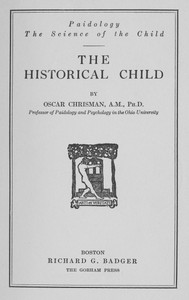
The Historical Child Paidology; The Science of the Child — Edition Insights
(0 User reviews)
1140
Project Gutenberg
2014
Not confirmed
Manners and customs; Children
Readers of public-domain and historical texts
Project Gutenberg digital edition
en
Edition facts
Words
192,963
Reading time
839 min
Text sections
26
The catalog record for The Historical Child Paidology; The Science of the Child — Edition Insights provides practical reading context through 192,963 words, 13 hr 59 min estimated reading time, and 26 detected text sections.
The text analysis averages about 22.1 words per sentence, while the detected sections provide another way to judge how the source is divided.
Project Gutenberg metadata also associates the work with “Manners and customs,” connecting these edition facts with the source record’s subject description.
Source:
Project Gutenberg record #46474
Oscar Chrisman's 1920 study examines childhood across ancient civilizations, using Roman spectacles to argue that public brutality shaped national character. The author, who coined 'paidology,' blends ethnographic detail with moral commentary.
Editorial Edition Score
4.9/5
★★★★★
★★★★★
Calculated from edition completeness, EPUB availability, text structure and catalogue metadata. Not a user rating.
How this score is calculated
- Description quality20 pts
- Title & short description10 pts
- Source metadata20 pts
- Text length15 pts
- Chapters / structure15 pts
- EPUB file integrity20 pts
Total of 100 points, scaled to a 2.5-5.0 range. Editions with an empty description or a missing EPUB file are not scored.
Edition quality
Public-domain source text
Read the source text
The source text is kept in the dedicated reader, separate from this catalogue record and its commentary.
Oscar Chrisman, who coined the term paidology in 1893, frames The Historical Child as the first of a series on child life across nations. The preface reveals his conviction that understanding children requires studying their place in past societies. The excerpts focus on Roman entertainments—gladiatorial combats, wild animal hunts, and naval battles—which Chrisman uses to argue that such spectacles hardened Roman character. His prose moves between cataloging historical facts and delivering pointed moral judgments, as when he describes the arena as a 'school of blood.'
A Moral Argument Dressed as Ethnography
Chrisman does not simply describe Roman amusements; he interprets them as evidence of national character. After detailing gladiatorial shows, he writes that 'the school of blood in which the young were reared… was eminently calculated to form precisely the character which the Roman possessed.' This sentence encapsulates his method: a claim about cause and effect, linking public violence to emotional hardening. The tone is that of a moralist, not a neutral observer. He uses phrases like 'can certainly surprise no one' to align the reader with his judgment. The effect is a work that blends ethnographic cataloging with a clear thesis about the relationship between customs and collective psychology.
Cataloging Cruelty: The Structure of Roman Spectacles
The excerpts list gladiatorial combats, venationes (wild animal displays), and naumachiae (naval battles) in a systematic fashion. Chrisman provides dates, numbers, and names: the first venatio in 186 B.C., the first naval battle by Julius Caesar in 46 B.C. with 1,000 marines and 2,000 oarsmen per side. He notes that animals were 'starved to make them fierce with hunger' and that captives were 'bound to stakes.' This accumulation of detail serves his argument: the sheer scale and variety of cruelty, he implies, could not help but shape Roman character. The structure is that of a list, but each item reinforces his moral point.
Voice and Pace: From Dry Record to Indignant Commentary
Chrisman's narrative voice shifts between two registers. One is the dispassionate chronicler: 'The first known display of wild animals at Rome was given by Marcus Fulvius Nobilior… in 186 B.C.' The other is the indignant moralist: 'It can certainly surprise no one that the Roman character… possessed so much hardihood.' The pace accelerates when he moves from fact to judgment. In the passage on theatrical entertainments, he notes that tragedy 'was never popular with the masses as they were too much used to seeing real tragedies enacted in the arena.' This sentence compresses his entire thesis into a single ironic observation. The alternation between these voices gives the text a rhythmic quality, as if the author cannot long contain his outrage.
Readers should approach The Historical Child as a work of early 20th-century social science, where the author's moral framework is as much a subject of study as the ancient practices he describes. Chrisman's use of the term 'paidology' signals his ambition to create a new discipline, but the excerpts show him operating as much as a cultural critic as a scientist. Pay attention to when he shifts from reporting to judging—those moments reveal the book's underlying argument about the relationship between childhood, custom, and national character.
Leafing through Chrisman’s grim pages on Roman crowds, I felt the weight of all that unseen history. It made me think of a quieter book, one that lingers on the ash-covered streets instead of the blood-soaked arenas. There is something tender in that contrast. The Wonders of Pompeii — Text and Context feels like a whispered echo of a world Chrisman only traced in outline.
There are no reviews for this eBook.
There are no comments for this eBook.
Reader reflection
Your personal reading reflection
Build a private reading journal entry for this title.
Your progress
0
/
10
2
How much did you enjoy the reading experience?
3
Would you recommend this book to another reader?
4
What was the reading difficulty like?
5
Did you relate to its people, ideas, or situations?
6
How useful were the ideas in this book?
7
How distinctive were its ideas or approach?
8
How clearly were the main ideas presented?
9
What changed or sharpened your thinking?
10





![Cover of Historical and descriptive sketches of the town and soke of Horncastle [1822] in the county of Lincoln and several places adjacent — Reading Companion](https://ambki.com/storage/media/covers/pg62327.jpg)