1

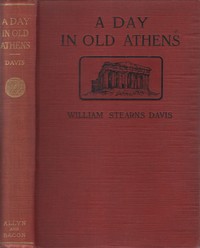
A Day in Old Athens; a Picture of Athenian Life — Background and Themes
(0 User reviews)
83
Project Gutenberg
2003
Not confirmed
Athens (Greece) -- Social life and customs
Readers of public-domain and historical texts
Project Gutenberg digital edition
en
Edition facts
Words
77,758
Reading time
339 min
Text sections
23
The source record for A Day in Old Athens; a Picture of Athenian Life — Background and Themes measures this digital text at 77,758 words, 5 hr 39 min estimated reading time, and 23 detected text sections.
The text analysis averages about 19.7 words per sentence, while the detected sections provide another way to judge how the source is divided.
Project Gutenberg metadata also associates the work with “Athens (Greece) -- Social life and customs,” connecting these edition facts with the source record’s subject description.
Source:
Project Gutenberg record #4716
An editorial note examining William Stearns Davis's authorial choices in diction, dialogue, and description within 'A Day in Old Athens,' focusing on how he constructs a vivid, sensory portrait of fourth-century B.C. Athenian life through specific, observable textual features.
Editorial Edition Score
4.9/5
★★★★★
★★★★★
Calculated from edition completeness, EPUB availability, text structure and catalogue metadata. Not a user rating.
How this score is calculated
- Description quality20 pts
- Title & short description10 pts
- Source metadata20 pts
- Text length15 pts
- Chapters / structure15 pts
- EPUB file integrity20 pts
Total of 100 points, scaled to a 2.5-5.0 range. Editions with an empty description or a missing EPUB file are not scored.
Edition quality
Public-domain source text
Read the source text
The source text is kept in the dedicated reader, separate from this catalogue record and its commentary.
William Stearns Davis opens A Day in Old Athens with a striking authorial gambit: he proposes to transport the reader to the fourth century B.C. “by some legerdemain,” a phrase that signals both the book’s imaginative ambition and its grounding in scholarly caution. The preface declares that “rare happenings have been omitted” and that “probable matters have been stated as if they were ascertained facts,” establishing a deliberate tension between historical fidelity and narrative convenience. This editorial note examines the specific authorial choices—in diction, dialogue, and description—that Davis employs to construct his picture of Athenian life, drawing evidence from the excerpts provided.
Diction: The Texture of the Everyday
Davis’s word choices consistently anchor the reader in the tangible, sensory details of Athenian experience. In describing the Peiraeus, he lists “corn, for onions, for leeks, for figs,” then adds “wreaths, anchovies, flute girls, blackened eyes”—a catalogue that moves from staple goods to the chaotic, human texture of the harbor. The phrase “built-up cow trails” for Athens’ crooked streets is deliberately homely, contrasting with the “straight” streets of the Peiraeus laid out by Hippodamus. Davis also uses technical terms like Lembus and Emporium without over-explaining, trusting the reader to absorb them from context. His diction is precise but not pedantic: “shining tunnies” and “dirty orange sail” evoke color and condition, while “grinning Ethiopians” and “long-bearded Babylonians” sketch a cosmopolitan port in a few strokes.
Description: The Craft of the Visual
Davis’s descriptive method relies on cumulative, concrete detail rather than abstract summary. The harbor scene is built from “ships of all kinds under sails or oars,” “the hammering of oars from the dock yards,” and “the fitting of rowlocks”—a sequence that mimics the sensory overload of the actual place. He often uses a present-tense, guided-tour syntax: “We now descend to the Peiraeus proper and examine the merchant shipping.” This creates an illusion of immediacy, as if the reader is physically present. The description of the Deigma (sample house) and the “Corn Exchange built by Pericles” grounds the scene in specific architecture. Davis also employs contrast: the “matchless spectacle” of the bay versus the “confusion” of the wharves, the “peaceful” view versus the “work and bustle” below.
Dialogue and Reported Speech: The Voices of the City
Davis rarely invents direct dialogue, but he incorporates reported speech and literary echoes to give voice to the city. He quotes Aristophanes’ Acharnians to capture the cacophony of the Peiraeus: “sailors clamoring for pay, rations being served out, figureheads being burnished.” This is not a character speaking but a chorus of activities, each with its own implied speaker. The phrase “Time fails us for mentioning” personifies the narrative itself, as if the tour guide is pressed for time. Davis also includes prayers and vows: shipmen offering “prayer ere hoisting sail” and paying “grateful vows after surviving a storm.” These are generic but culturally specific, anchoring the scene in religious practice. The mention of Isocrates’ boast about the Emporium adds an authoritative, civic voice without direct quotation.
Structure and Point of View: The Guided Gaze
Davis structures the narrative as a continuous, first-person-plural tour: “we soon discover,” “we find,” “we can now cast more particular eyes.” This consistent point of view creates a sense of shared discovery and limits the scope to what a hypothetical visitor could see and hear. The year 360 B.C. is chosen not for its historical drama but for its architectural and social “perfection,” a judgment that shapes the book’s selective focus. Davis acknowledges that he has “stated no facts” that would not be obvious to a reader with “merely an elementary knowledge of Greek annals,” which explains the explanatory asides (e.g., the footnote on Hippodamus). The result is a hybrid: part scholarly reconstruction, part imaginative travelogue, held together by a disciplined authorial voice that never breaks character.
Davis’s authorial choices—his concrete diction, his sensory descriptions, his use of reported voices, and his guided-tour structure—work together to create a remarkably vivid and coherent picture of fourth-century Athens. He does not claim to present the whole truth, but rather a plausible, engaging vision grounded in evidence. Readers attentive to these choices will find the book not just a source of information but a crafted artifact of historical imagination, one that rewards close attention to how its picture is made.
The rain against the window blurred the narrow Athenian streets, and Davis’s quiet detail—a vendor’s cry, the smell of olive oil—stayed with me long after I set the book down. That afternoon, a footnote about Roman unrest nudged me toward The Wars of the Jews; Or, The History of the Destruction of Jerusalem — Context and Discussion. Both worlds felt equally fragile, equally human, waiting beneath the surface of their own certitudes.
There are no reviews for this eBook.
There are no comments for this eBook.
Reader reflection
What was your reading experience?
Capture what you thought, learned, and would like to remember.
Your progress
0
/
10
2
How did the book work for you overall?
3
Would you encourage someone else to read it?
4
How easy was the book to follow?
5
Would this book work well in a reading group?
6
Which aspect of the book did you value most?
7
How understandable was the text?
8
Is this a title worth rereading?
9
In one sentence, what did you learn?
10