1

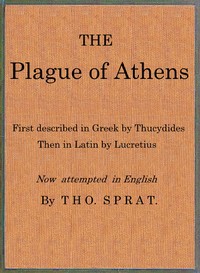
The Plague of Athens, which hapned in the second year of the Peloponnesian Warre First described in Greek by Thucydides; then in Latin by Lucretius. Now attempted in — Text and Context
(0 User reviews)
1764
Project Gutenberg
2021
Not confirmed
Greece -- History -- Peloponnesian War, 431-404 B.C.; Plague -- Greece -- Athens
Readers of public-domain and historical texts
Project Gutenberg digital edition
en
Edition facts
Words
10,956
Reading time
48 min
Text sections
8
The Plague of Athens, which hapned in the second year of the Peloponnesian Warre First described in Greek by Thucydides; then in Latin by Lucretius. Now attempted in — Text and Context can be approached with a clearer sense of reading commitment from its source measurements: 10,956 words, 48 min estimated reading time, and 8 detected text sections.
The text analysis averages about 30.2 words per sentence, while the detected sections provide another way to judge how the source is divided.
Project Gutenberg metadata also associates the work with “Greece -- History -- Peloponnesian War, 431-404 B.C.,” connecting these edition facts with the source record’s subject description.
Source:
Project Gutenberg record #65972
Thomas Sprat's 1665 poetic translation of Thucydides' and Lucretius' accounts of the Athenian plague, framed by a dedicatory letter to Dr. Walter Pope that candidly addresses the challenges of writing from secondhand experience.
Editorial Edition Score
4.6/5
★★★★★
★★★★★
Calculated from edition completeness, EPUB availability, text structure and catalogue metadata. Not a user rating.
How this score is calculated
- Description quality20 pts
- Title & short description10 pts
- Source metadata20 pts
- Text length15 pts
- Chapters / structure15 pts
- EPUB file integrity20 pts
Total of 100 points, scaled to a 2.5-5.0 range. Editions with an empty description or a missing EPUB file are not scored.
Edition quality
Public-domain source text
Read the source text
The source text is kept in the dedicated reader, separate from this catalogue record and its commentary.
Thomas Sprat's 1665 poem, The Plague of Athens, is a curious hybrid: a verse translation that openly acknowledges its distance from the events it describes. In the dedicatory letter to Dr. Walter Pope, Sprat admits he writes “by an Idea of that which I never yet saw, nor care to feel,” contrasting his position with Thucydides, who witnessed the plague firsthand. This self-consciousness about mediated experience shapes the poem's texture. Sprat works from two classical sources—Thucydides' Greek history and Lucretius' Latin poetic version—and his English rendering often amplifies the grotesque: vultures that “avoid the dead men more / Than weaker birds did living men before,” or corpses that “even after death … all are murderers here.” The result is less a faithful translation than a baroque meditation on horror at one remove.
A Poet Distant from His Subject
The dedicatory epistle to Dr. Walter Pope is more than a courtesy; it is a methodological confession. Sprat compares his disadvantage to that of a painter who “thrust himself into the midst of a Fight” to depict it better—a painter he explicitly declines to emulate. He notes that Thucydides, having been “assaulted by the disease himself, had the horror familiar to his Eyes,” while Lucretius “was forced to allow his foot-steps, and onely work on that matter he allow’d him.” Sprat places himself even further from the scene, denied “many of the circumstances, customes of the Countrey, and other small things.” This framing invites readers to consider the poem not as a direct report but as a literary reconstruction, shaped by the gaps in available knowledge.
Stanza, Structure, and the Grotesque
The poem is divided into numbered stanzas (XVIII–XXII in the excerpts), each a self-contained vignette of suffering. Sprat favors abrupt shifts in scale: a stanza may move from “Mountains of bones and carcases” to a mother and child, then to prisoners who “gain a two-fold liberty” by dying. The verse form is irregular—lines vary in length, and rhyme schemes shift unpredictably—which mirrors the disorder it describes. Recurring motifs include failed natural order: vultures refuse carrion, dogs flee domestication, owls depart Athens “in open day.” The plague corrupts not only bodies but the very categories of life and death, as in the line “Their bodies kill all that come near, / And even after death they all are murderers here.”
Catalog Subjects vs. Poetic Evidence
The catalog lists this work under “Greece -- History -- Peloponnesian War, 431-404 B.C.” and “Plague -- Greece -- Athens,” which accurately reflect its classical sources. Yet the excerpts reveal a poem that is far from a straightforward historical account. Sprat’s dedicatory letter emphasizes his remove from the events, and the verse itself is shaped by literary conventions—personification of the Fates, rhetorical apostrophe, and baroque hyperbole—that belong to seventeenth-century English poetry rather than Thucydidean historiography. The poem’s emotional register is also distinct: it dwells on the breakdown of social bonds (friends, families, servants) and the futility of prayer, themes that resonate with Sprat’s own era’s plague literature. Readers should approach the text as a creative response to classical models, not as a transparent window onto ancient Athens.
The Dedicatory Letter as a Key
Sprat’s letter to Dr. Walter Pope is not merely a preface; it is an integral part of the work’s argument. In it, Sprat explicitly compares his own method to that of Thucydides and Lucretius, laying out the challenges of writing about a plague he never witnessed. He mentions Alexander’s refusal to be painted by any but a “celebrated Pencil,” implying his own inadequacy. This self-deprecation is strategic: it frames the poem as an imperfect but earnest attempt, and it invites the reader to judge the translation against its originals. The letter also reveals Sprat’s awareness of the 1665 London plague context—the poem was published in that year—though he never directly mentions it. This historical coincidence adds a layer of immediacy that the poem itself does not explicitly acknowledge.
Sprat’s Plague of Athens rewards readers who attend to its framing devices as much as its vivid stanzas. The dedicatory letter, the irregular verse, and the poem’s self-conscious distance from its subject all mark it as a work of literary ambition rather than mere translation. For those interested in how seventeenth-century writers processed catastrophe through classical lenses, this short poem offers a concentrated case study. Compare it with the original Thucydides and Lucretius passages to gauge Sprat’s choices—and consider what it means to write about disaster from a safe remove.
I remember sitting with this plague text, feeling the odd ache of writing about something I’d never witnessed—secondhand sorrow, yet real. It reminded me of leafing through The Seven Great Monarchies Of The Ancient Eastern World, Vol 1: Chaldaea The History, Geography, And Antiquities Of Chaldaea, Assyria, Babylon, Media, Persia, Parthia — Inside the Classic, where ruins spoke through another’s careful hands. Both times, the distance didn’t dull the feeling—it deepened it, like hearing rain from inside a warm room.
There are no reviews for this eBook.
There are no comments for this eBook.
Reader reflection
What did you think of this book?
Answer a few questions and save a private reflection on this device.
Your progress
0
/
10
2
What was your overall reaction to the book?
3
Would you encourage someone else to read it?
4
How demanding did the text feel?
5
Was the book moving at the right speed?
6
Which element worked best for you?
7
Would you like to discuss this book with someone?
8
How strongly did the book affect you emotionally?
9
In one sentence, what did you learn?
10