1

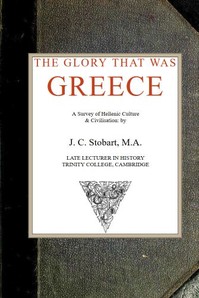
The Glory That Was Greece: a survey of Hellenic culture and civilisation — Text and Context
(0 User reviews)
75
Project Gutenberg
2019
Not confirmed
Art, Greek; Greece -- Civilization -- To 146 B.C.
Readers of public-domain and historical texts
Project Gutenberg digital edition
en
Edition facts
Words
103,731
Reading time
452 min
Text sections
20
The Glory That Was Greece: a survey of Hellenic culture and civilisation — Text and Context can be approached with a clearer sense of reading commitment from its source measurements: 103,731 words, 7 hr 32 min estimated reading time, and 20 detected text sections.
The text analysis averages about 20.8 words per sentence, while the detected sections provide another way to judge how the source is divided.
Project Gutenberg metadata also associates the work with “Art, Greek,” connecting these edition facts with the source record’s subject description.
Source:
Project Gutenberg record #59532
J. C. Stobart's 1911 survey of Hellenic culture, using archaeology, history, and literary criticism to present a panoramic view of Greek civilization, with particular attention to Athens, its art, and its political and intellectual freedoms.
Editorial Edition Score
4.9/5
★★★★★
★★★★★
Calculated from edition completeness, EPUB availability, text structure and catalogue metadata. Not a user rating.
How this score is calculated
- Description quality20 pts
- Title & short description10 pts
- Source metadata20 pts
- Text length15 pts
- Chapters / structure15 pts
- EPUB file integrity20 pts
Total of 100 points, scaled to a 2.5-5.0 range. Editions with an empty description or a missing EPUB file are not scored.
Edition quality
Public-domain source text
Read the source text
The source text is kept in the dedicated reader, separate from this catalogue record and its commentary.
Stobart opens his preface by likening classical scholars to miners working in isolated shafts, a metaphor that sets the tone for a work self-consciously positioned between encyclopedic reference and personal panorama. He acknowledges the impossibility of matching earlier generalists like Grote or Mommsen, yet aims to offer a coherent, individual view of Hellenic culture. The excerpts show that his method is to blend archaeological evidence with literary and historical analysis, as when he discusses the Parthenon sculptures and the circle around Pericles. Readers should note that Stobart frequently uses the first person and addresses the reader directly, making his survey an argument as much as a description.
The Author's Stance and Scope
Stobart’s preface reveals a deliberate choice: to sacrifice detail for a broad panorama. He contrasts his approach with the “colossal dictionaries” of specialist scholarship, and warns that he will “tread upon innumerable toes.” This is not a neutral textbook but a personal synthesis. The excerpts from later chapters show him applying this method to Athens, where he argues that the city’s freedom—political and intellectual—was real, though enabled by slavery. He notes that attacks on Pheidias, Pericles, and Socrates “may all be explained on political grounds,” a claim that reflects his interpretive boldness. Readers should expect a work that is opinionated and selective, not a comprehensive reference.
Athens as a Living City
Stobart paints Athens as a place of daily stimulation: “speeches and debates in law-court and Assembly,” festivals, conversations in the agora and palaestra, and constant traffic from abroad. He emphasizes the “open air” life and the role of slaves in freeing citizens for intellectual pursuits. The portrait is drawn from Pericles’ funeral oration as reported by Thucydides, which Stobart quotes approvingly: “culture without extravagance, and philosophy without softness.” He also describes Aspasia’s salon, where “Pheidias the sculptor, Damon the musician, Anaxagoras the philosopher, Alcibiades, and Socrates” gathered. This is a vivid, almost novelistic reconstruction, but Stobart grounds it in specific sources and material remains.
Art and Patronage Under Pericles
The excerpts on the Parthenon show Stobart’s interest in the intersection of art, politics, and personality. He notes that Pericles “set the example which Athens followed of encouraging talent from all quarters,” and that the rebuilding of the city provided a “rare opportunity for the artists.” He identifies Pheidias and Ictinus as the directors, and traces Pheidias’ training under Agelâdas of Argos. Technical details—the “archaic smile,” the rendering of hair—are used to place Pheidias at the beginning of fine art. Stobart’s narrative moves from the general to the specific, linking the political context to the evolution of sculptural technique.
The Limits of the Excerpts
The provided excerpts cover only the preface and a portion of the chapter on Periclean Athens. They do not include Stobart’s treatment of earlier Greek history, other city-states, or later periods. His discussion of slavery is brief but pointed: “We must never forget the thousands of slaves whose cruel toil in mine and factory rendered this brilliant society possible.” This suggests a critical edge that may reappear elsewhere. The excerpts also lack his handling of literature, religion, or the Hellenistic age. Readers should approach the full text as a selective survey, not a complete history, and be prepared for Stobart’s distinctive voice throughout.
Stobart’s survey is best read as a companion to the primary sources and monuments he discusses. His willingness to generalize and to take sides makes the book engaging but also requires the reader to weigh his claims against other scholarship. The excerpts suggest that the work is strongest on fifth-century Athens and its artistic achievements, but the full scope—from prehistoric Greece to the Roman conquest—is only hinted at. For a first reading, focus on Stobart’s method: how he weaves together archaeology, history, and personal judgment to create a coherent vision of Hellenic culture.
That rainy afternoon, Stobart’s Glory That Was Greece kept me company, its pages damp with the smell of old paper. I lingered on Athens, its freedoms so vivid. Later, idle, I wondered what lay east of that bright world, and found myself holding The Seven Great Monarchies Of The Ancient Eastern World, Vol 1: Chaldaea The History, Geography, And Antiquities Of Chaldaea, Assyria, Babylon, Media, Persia, Parthia — Inside the Classic. The shift felt natural, like walking from one room into another.
There are no reviews for this eBook.
There are no comments for this eBook.
Reader reflection
How did this book work for you?
Your answers remain private and are stored only in this browser.
Your progress
0
/
10
2
How did the book work for you overall?
3
Would you pass this book on to a friend?
4
Did the language feel accessible?
5
Did anything about the book feel genuinely new?
6
Did this book create an emotional response?
7
Is this a title worth rereading?
8
How would you describe its reading pace?
9
What did this book teach you most?
10